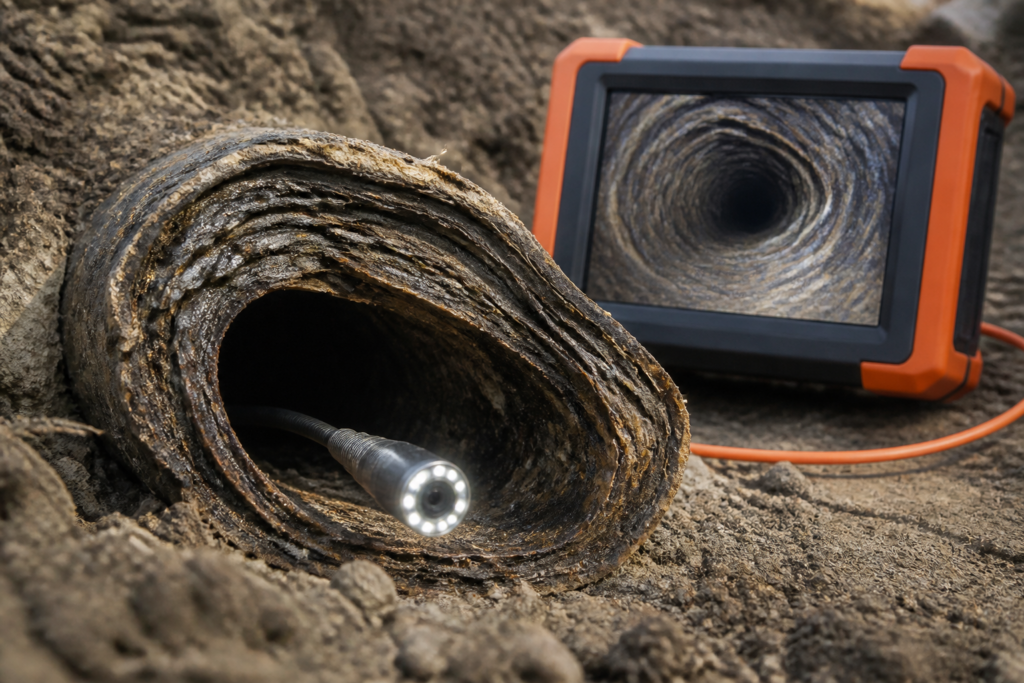




A sewer camera can reveal conditions that make Orangeburg pipe a reasonable suspicion, but one camera view usually cannot confirm the material by itself. Dark color, a layered or fibrous-looking wall, an oval opening, blistering, deformation, or collapse can be important clues. They must be interpreted across the full recording and checked against the property’s age, pipe transitions, accessible material, location measurements, and service history.
The most useful question is not simply, “Is this Orangeburg?” It is, “What does the complete evidence show about the pipe’s material, shape, strength, and ability to carry wastewater?” A label alone does not determine whether the line should be monitored, cleaned carefully, lined, replaced by pipe bursting, or exposed through excavation.
What Orangeburg Pipe Is
Orangeburg is the common name for a fiber-based pipe made from compressed layers bonded with a bituminous material. It was used for some underground sewer laterals in older properties. Unlike rigid clay, cast iron, or modern plastic, this material can lose its round shape and develop layered deterioration as it ages or is exposed to long-term loading and moisture.
Property age can make Orangeburg more plausible, but age is only supporting evidence. An older home may have another original material, a partial replacement, or several materials joined along one lateral. A newer-looking cleanout near the house also does not prove the entire buried line was replaced. The recording should show where visible material or shape changes occur and whether the suspicious section continues beyond that point.
Camera Clues That May Suggest Orangeburg
A plumber reviewing complete footage may become suspicious when several compatible conditions appear together:
- A dark brown or nearly black interior surface rather than the typical appearance of clay, cast iron, or plastic
- A layered, fibrous, rippled, or paper-like wall texture
- An opening that has become oval, flattened, or pinched instead of remaining round
- Blistering, peeling, delamination, or folds along the inner wall
- A section that narrows gradually as the pipe loses shape
- A visibly crushed or collapsed area
- Roots or debris entering where the wall or a connection has deteriorated
- A transition from a clearly different pipe material into the suspicious section
No single item on that list proves Orangeburg. Roots can enter damaged joints in several pipe materials. Deposits can create a dark or rough surface. A camera pressed against one wall can make a round pipe look distorted. Standing water, glare, residue, and limited lighting can hide the true wall texture. Identification becomes more reliable when several clues remain consistent across a meaningful length of the completed run.
Why One Dark Camera Frame Is Not Conclusive
Sewer-camera footage is affected by lens position, light reflection, water, debris, and the distance between the camera head and the pipe wall. A close view may magnify residue until it looks like layered pipe. A tilted camera can make the opening look oval. Dark buildup can cover the material beneath it, while bright LEDs can wash out texture and color.
The camera also views only the interior. It cannot directly show the exterior wall, surrounding soil, bedding, or how much structural strength remains. The recording may document deformation or missing material without establishing why it happened. Soil movement, external loading, root pressure, prior work, and long-term material deterioration can create overlapping interior conditions.
That is why a responsible interpretation uses more than the clearest screenshot. The plumber should review the approach to the suspicious section, the full section itself, the pipe beyond it, and any reverse footage that improves the view.
What a Complete Camera Run Should Document
A professional sewer camera inspection in Los Angeles should preserve enough context to distinguish a material suspicion from a one-frame guess. Useful footage may document:
- The visible material and shape before the suspicious section
- The point where color, wall texture, joint style, or diameter changes
- Whether the opening stays round or becomes progressively deformed
- Whether blistering or layered separation appears in more than one view
- Whether roots, paper, scale, grease, or debris obscure the wall
- Whether the camera travels through the full intended run
- Whether nearby joints, connections, or branches remain visible
- Whether the same condition continues or returns elsewhere
- The camera’s distance reading and a surface-located position when needed
- The condition of the pipe after the suspicious section
The full run matters because a short dark section could be buildup, a repair transition, or a lighting change. A long section with consistent layered texture and loss of round shape provides stronger evidence, although exposed material or records may still be needed for confirmation.
If the camera cannot move past an obstruction, the material and condition beyond that point remain unknown. That situation requires a different evidence sequence from a completed Orangeburg assessment. A homeowner facing an impassable inspection can review what happens when a sewer camera cannot get past a blockage without treating the unseen pipe as confirmed Orangeburg.
Evidence That Can Corroborate the Footage
Several independent details can strengthen or weaken the material identification:
Property and repair history
Construction era, plumbing permits, invoices, prior inspection reports, and seller disclosures may indicate what was installed or replaced. Records can be incomplete, so they should be compared with the current footage rather than accepted as proof of every buried section.
Accessible pipe material
A safe, already exposed segment may provide direct material evidence. A plumber may be able to compare pipe at a cleanout, an existing access point, or a documented repair location with the buried section. Homeowners should not open a cleanout, cut pipe, or excavate to investigate on their own.
Transitions and location
The camera may show a clear transition between materials. A distance counter and surface locator can help establish where that transition sits and whether it aligns with a known repair. Cable distance is useful but may not be exact enough by itself for excavation planning.
Dimensions and shape
The apparent diameter, wall profile, joint pattern, and consistency of deformation can add context. Camera perspective can distort size, so a single apparent measurement should not be treated as conclusive.
Symptoms and earlier recordings
Recurring backups, repeated root removal, restrictions at the same located section, or older footage showing progressive deformation can affect the condition assessment. Symptoms do not prove material. They help explain whether the observed section is interfering with service or changing over time.
The Pipe’s Condition Matters More Than the Label Alone
Two lines suspected of being Orangeburg may need different next steps. One may remain open and reasonably round with no documented service problem at that location. Another may be flattened, delaminating, repeatedly obstructed, or partially collapsed. The actual shape, usable opening, wall condition, length involved, access, and symptom history should define the recommendation.
Likewise, identifying Orangeburg does not automatically justify replacing the entire sewer lateral. The recording may show that only one section is suspicious, that other sections use different materials, or that the inspection did not clearly evaluate the full route. Any proposed scope should distinguish confirmed deterioration, suspected material, serviceable pipe, and unseen areas.
When Documented Monitoring May Be Reasonable
Monitoring may be considered when the suspicious section remains open, largely round, and traversable; the wall does not show obvious advanced delamination or collapse; nearby pipe appears serviceable; and the property’s history does not show a recurring problem at that location.
A useful monitoring baseline includes the complete dated video, the located start and end of the section, the symptoms that prompted inspection, any cleaning performed before the recording, and the conditions that would trigger another evaluation. Saving one screenshot is not enough because a later plumber needs comparable footage and location context.
Monitoring is not the same as declaring the pipe permanent or problem-free. It is a condition-based choice to preserve evidence and watch for a defined change rather than recommending work from the material label alone.
Cleaning May Improve the View but Does Not Restore the Pipe Wall
Roots, grease, scale, and debris can obstruct flow or hide the surface. When the observed pipe condition can safely receive an appropriate cleaning method, removing suitable material may improve drainage and provide a clearer second camera view.
Cleaning cannot make a flattened pipe round again, rebond separated layers, rebuild a soft-looking wall, or restore a collapsed opening. Equipment and pressure should be selected for the pipe that is actually present. A method that may be reasonable in sound rigid pipe may not be suitable for a severely deformed or deteriorated fiber section.
Ask what the first recording shows about structural condition, what material the operator intends to remove, and how the proposed method accounts for the suspected pipe. The purpose of a second camera run is to document the wall and opening more clearly, not to prove that aggressive cleaning can repair structural deterioration.
When Lining May or May Not Fit
Lining creates a new interior pathway within an existing route, but suitability depends on more than the word Orangeburg. The existing section must be evaluated for shape, remaining opening, continuity, cleanability, connections, length, and access. Significant flattening, collapse, missing structure, or another condition may prevent a liner from creating an acceptable finished opening.
A recommendation should explain which footage and measurements support lining, how the section would be prepared, which connections are involved, and what condition would make the method unsuitable. No camera screenshot can promise liner eligibility before those details are established.
When Pipe Bursting or Excavation May Be Considered
Pipe bursting and excavation address different access and site conditions. Pipe bursting may use an existing route in some cases, but the route, launch and receiving access, utilities, connections, alignment, and surrounding conditions still matter. Excavation may provide direct access to a localized section or a route that cannot support another method, but the required area cannot be defined reliably from an interior image alone.
The broader sewer line repair and replacement decision should follow confirmed location and condition evidence. Ask the plumber to show which part of the recording supports the proposed boundary, which sections remain serviceable, and why the recommended method fits the actual route.
Keep Orangeburg Suspicion Separate From Other Camera Findings
A material question should not absorb every defect in the recording. A displaced connection is a joint-alignment finding even if the adjoining section may be fiber pipe. The homeowner can review what an offset sewer pipe joint means on camera without assuming that every offset proves Orangeburg.
The same separation applies to standing water, roots, and blockages. Standing water may suggest a grade problem or may temporarily obscure the view. Roots identify an entry path but do not identify the pipe material. A blockage may stop the inspection before the suspected section is fully seen. Each condition needs its own evidence and should be listed separately in the inspection findings.
Questions to Ask About Suspected Orangeburg
Use these questions when reviewing the recording and recommendation:
- Which visual clues make Orangeburg likely, and which other materials or deposits could look similar?
- Can I see those clues across the full section rather than in one paused frame?
- Where does the suspected material begin and end?
- Does the camera show a transition to another known material?
- Did the camera complete the intended run, and what remains unseen?
- Is the pipe still round and open, or is it flattening, blistering, delaminating, narrowing, or collapsing?
- Are roots, debris, or deposits hiding the wall?
- What property records, exposed pipe, measurements, or prior footage corroborate the identification?
- Which observed condition supports monitoring, careful cleaning, lining, pipe bursting, or excavation?
- What evidence defines the proposed repair length instead of assuming the entire lateral is affected?
Keep the complete video, written findings, location notes, and any before-and-after footage. Those records make a second opinion or later comparison more useful.
When to Stop Using Water and Request Prompt Help
If wastewater is actively backing up into a tub, shower, toilet, floor drain, or other fixture, stop using sinks, toilets, showers, laundry equipment, and dishwashers. Keep people and pets away from the affected water. Do not open a cleanout or insert a cable or camera into the line.
A suspected Orangeburg label without an active backup does not create the same immediate situation. Preserve the footage and arrange a focused review of the material evidence, structural condition, and location so the next step matches what is actually documented.
Frequently Asked Questions
Can a sewer camera confirm Orangeburg pipe by color?
Color alone is not conclusive. Orangeburg may look dark brown or black, but deposits, lighting, and other materials can produce a similar appearance. Layered texture, deformation, transitions, full-run consistency, and corroborating evidence matter.
Does an oval pipe opening mean it is Orangeburg?
An oval or flattened opening can support the suspicion, especially when layered wall deterioration appears with it. Camera angle can also distort shape, and other pipe conditions can cause deformation. Review the section from multiple positions and compare the surrounding run.
Does every Orangeburg sewer line need immediate replacement?
No decision should rest on the material name alone. The usable opening, wall condition, length involved, symptoms, access, and evidence of progression should support monitoring or repair. Advanced flattening, delamination, repeated obstruction, or collapse may justify a different response from a stable, open section.
Can hydro jetting fix Orangeburg pipe?
Cleaning may remove suitable deposits or roots and improve the camera view when the observed condition can safely receive that method. It does not restore a deformed, separated, or collapsed fiber wall. The equipment and pressure must fit the documented pipe condition.
Can Orangeburg always be lined?
No. Lining eligibility depends on shape, remaining opening, continuity, cleanability, connections, access, and the proposed finished pathway. Significant deformation or collapse may make lining unsuitable. A complete evaluation is needed before selecting the method.
Is property age enough to prove Orangeburg is present?
No. Age can support the possibility, but homes may contain original pipe, partial replacements, and several materials. Records, exposed accessible pipe, transitions, and full camera footage provide stronger evidence together.
Request a Focused Sewer-Camera Review in Los Angeles
If your inspection report says “Orangeburg” or “possible Orangeburg,” preserve the full video instead of relying on one screenshot. Note where the suspicious section begins and ends, keep any prior repair records, and list recurring drainage symptoms. Papa’s Plumbing can review the footage and location evidence, explain what is confirmed and what remains uncertain, and connect any recommendation to the pipe’s documented condition rather than the label alone. Request a sewer camera inspection to clarify the next safe step for your Los Angeles property.