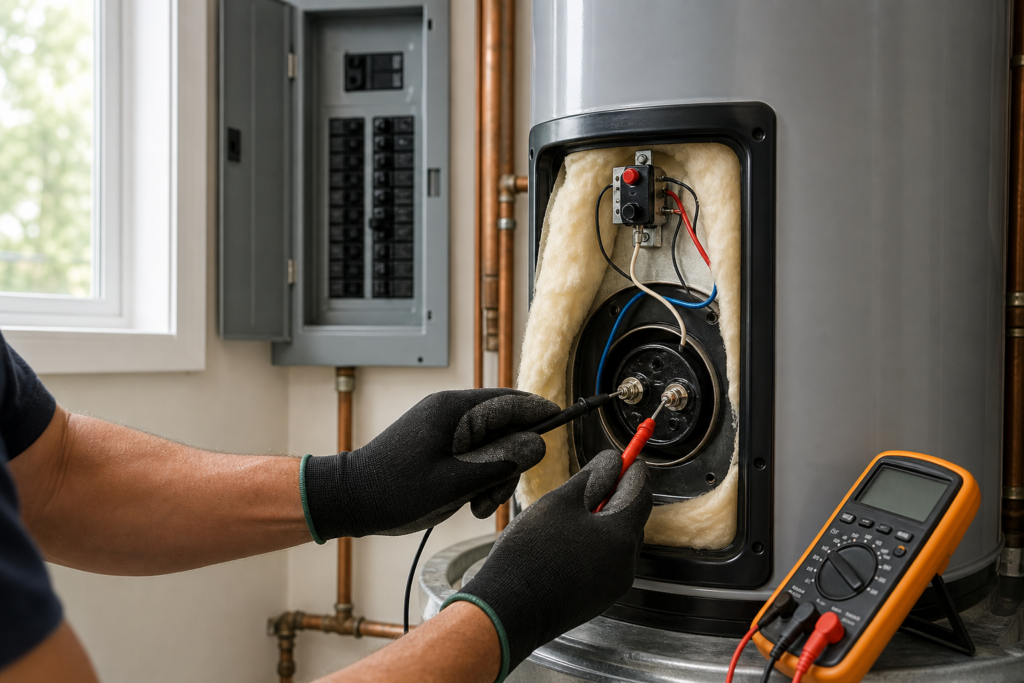




If your electric water heater trips its circuit breaker, treat the trip as a warning. If conditions are dry and there is no burning odor, unusual heat, buzzing, smoke, sparks, or visible damage, follow the manufacturer’s instructions for no more than one reset. If the breaker trips again, leave it off and arrange a qualified diagnosis. Repeatedly resetting it can re-energize a fault without fixing the cause.
Leave the breaker off immediately if water is near the heater, wiring, disconnect, or electrical panel. Do the same if the breaker will not stay set, the panel feels unusually hot, or you notice a burning smell, buzzing, smoke, or sparks. Keep away from wet surfaces and do not touch the heater or panel to investigate.
Why the Breaker Trips
The breaker protects the water heater’s branch circuit from electrical conditions that could overheat wiring or energize damaged components. A trip does not identify the failed part by itself. It means the circuit detected more current or a different current path than it should allow.
An electric tank water heater normally uses heating elements, thermostats, a high-limit safety control, internal wiring, and a dedicated electrical supply. A fault in the heater can trip the breaker, but the breaker, its panel connection, or the branch-circuit wiring can also be responsible. The safest repair starts by determining whether the problem is inside the water heater or in the circuit supplying it.
A Heating Element May Be Leaking Current to Ground
Electric heating elements sit inside the tank and transfer heat directly into the water. The electrical conductor is insulated from the surrounding metal sheath. If that insulation breaks down, electricity can find a path to the water or the grounded metal tank instead of remaining inside the element.
An element fault may trip the breaker as soon as power returns. In other cases, the trip may happen only after the element energizes or warms. That timing can help a technician plan the test, but it does not prove the element is bad.
A qualified technician can isolate power, verify that the circuit is de-energized, disconnect the element correctly, and test resistance between its terminals and from each terminal to ground. Homeowners should not remove the access covers, move insulation, touch terminals, or place meter probes inside the heater. Electric water heaters commonly use high voltage, and a breaker handle alone is not a substitute for verifying that the equipment is de-energized.
Thermostat, High-Limit, and Internal Wiring Faults
The thermostats control when the upper and lower elements receive power. A high-limit control is intended to interrupt operation if temperature rises beyond its safe range. Loose terminals, heat-damaged conductors, a failed thermostat, or a problem in that control circuit can create excess heat or an unintended electrical path.
The internal high-limit reset is not the same device as the circuit breaker in the home’s electrical panel. Pressing an internal reset requires opening the heater’s electrical access area, where hazardous voltage may be present. Do not open the panel or press internal controls to see whether the heater starts again.
Burning odor, discolored insulation, melted wire covering, or heat around an access plate are stop-use conditions. Leave the circuit off. A technician should determine what overheated and why before replacing a part or restoring power.
Moisture Can Turn a Plumbing Leak Into an Electrical Hazard
Water may reach electrical parts from a leaking supply connection, a valve, a fitting, an access opening, or a failing tank. Condensation can also appear around some installations, but it should not be assumed harmless when the breaker is tripping.
Do not remove an access cover to look for moisture. From a dry, stable location, note whether water is visible on the floor, running down the tank, collecting near the electrical connection, or appearing beneath a fitting. If the leak is active, keep the breaker off and avoid the wet area.
Water beneath the tank can have several sources. The location and first visible path matter more than the size of the puddle. Review the immediate safety steps for a water heater leaking from the bottom without assuming that every puddle means the tank wall has failed.
The Breaker or Branch Circuit May Need an Electrician
The water heater may test normally while the supply circuit still has a problem. A worn breaker, loose panel connection, damaged conductor, incorrect circuit arrangement, or poor connection at the heater disconnect can create heat and repeated trips. A replacement heater with different electrical requirements can also expose a mismatch between the equipment and the existing circuit.
Never replace the breaker with a larger size to keep it from tripping. The breaker must match the conductors and connected equipment. Upsizing it without correcting the circuit can remove protection from wiring that is already overheating.
A plumber may diagnose the heater, its elements, thermostats, controls, fittings, and tank condition. A licensed electrician may need to test the breaker, panel connection, conductors, disconnect, grounding, and branch-circuit capacity. The correct handoff depends on where testing locates the fault.
What the Trip Timing Can Tell the Technician
Write down what happened without recreating the problem. Useful observations include:
- Whether the trip occurred immediately when the breaker was reset
- Whether it happened after several minutes of heating
- Whether it followed a long shower or another period of high hot-water use
- Whether the heater had recently been drained, repaired, replaced, or exposed to a leak
- Whether hot water had become inconsistent before the trip
- Whether the unit was making a new noise
- Whether water, dampness, odor, heat, buzzing, smoke, or sparks were present
- Whether the breaker had tripped before and how recently
An immediate trip can be consistent with a direct short or a severe ground fault. A delayed trip may occur when a particular element energizes, a connection heats, or an intermittent fault appears. Those are diagnostic possibilities, not conclusions. Do not turn the circuit on again to improve the timeline.
Safe Checks That Do Not Require Opening Equipment
Limit homeowner checks to observations from a dry location:
1. Confirm that the tripped breaker is the one identified for the water heater without removing the electrical-panel cover. 2. Look for water around the tank, connections, disconnect, wall, and floor without touching wet equipment. 3. Note burning odor, buzzing, unusual heat, discoloration, smoke, or sparks from a safe distance. 4. Record when the trip occurred and what hot-water demand happened beforehand. 5. Photograph the outside of the heater, the surrounding dry area, and the breaker handle only if you can do so without approaching a hazard. 6. Keep the circuit off after a repeated trip and arrange service.
Do not remove either water-heater access plate. Do not pull insulation aside, press the internal reset, tighten terminals, disconnect wires, test with a meter, drain the tank, replace the breaker, or use an extension cord. Do not hold a breaker in position or defeat any protective device.
Why Flushing Is Not a Breaker-Trip Repair
Los Angeles water conditions can contribute to mineral deposits inside a tank. Sediment may reduce heat transfer, create noise, and increase stress on components. It does not make a repeated electrical trip safe to ignore, and flushing does not repair a grounded element, damaged wire, failing breaker, or wet electrical connection.
If the heater was rumbling or popping before the trip, tell the technician. Those symptoms may help describe the unit’s overall condition. They belong to a different diagnosis from the protective trip itself. Homeowners can learn why a gurgling water heater may indicate sediment while keeping the electrical circuit off until the trip is evaluated.
What Professional Testing May Include
After isolating the circuit and confirming that the heater is de-energized, a qualified professional may:
- Inspect the heater exterior, fittings, tank base, disconnect, and access areas for leakage or heat damage
- Verify the unit’s electrical rating against the supply
- Test each heating element for expected resistance and an unintended path to ground
- Inspect thermostats, the high-limit control, terminals, and internal conductors
- Check for loose, burned, or damaged connections
- Determine whether moisture entered an electrical compartment
- Confirm whether the water-heater fault is isolated or the branch circuit also needs evaluation
- Test the breaker, panel connection, conductors, grounding, and disconnect when electrical scope is indicated
The exact sequence depends on what is safe and accessible. Testing should separate observed facts from likely causes before any part is replaced.
When Repair May Be Reasonable
An isolated failed element, thermostat, high-limit control, terminal, or repairable connection may support a focused water-heater repair when the tank and remaining components are in serviceable condition. A correct repair also addresses any leak or overheating condition that contributed to the failure.
A breaker or branch-circuit fault requires correction on that electrical path. Replacing a heater component will not repair a loose panel connection, damaged conductor, or unsuitable circuit. Likewise, replacing a breaker will not correct an element that is leaking current to the tank.
When Replacement May Enter the Decision
Replacement may be considered when testing finds a leaking or corroded tank, extensive heat damage, multiple deteriorated components, an equipment rating that does not fit the intended installation, or a repair scope that is not sensible for the unit’s overall condition. Age alone does not make the decision, and a trip alone does not prove the heater must be replaced.
Ask which finding makes the unit repairable or non-repairable, whether the branch circuit also needs work, and what must be corrected before a new heater can be energized. A broader water heater replacement assessment in Los Angeles should connect the recommendation to documented tank, component, and circuit conditions.
Frequently Asked Questions
Can I reset the water-heater breaker once?
If the area is dry, the breaker and panel appear undamaged, and there is no burning odor, unusual heat, buzzing, smoke, sparks, or visible wiring damage, follow the manufacturer’s instructions for no more than one reset. If it trips again, leave it off. Do not keep testing it by repeated resets.
Why does the breaker trip only after a few minutes?
A delayed trip may happen when an element energizes, a damaged connection warms, or an intermittent fault appears. Timing helps plan testing but cannot identify the part. Leave the circuit off after the repeated trip.
Does a tripped breaker mean the heating element is bad?
Not necessarily. A heating element is one possibility, but thermostats, high-limit controls, internal wiring, moisture, the breaker, the panel connection, and branch-circuit wiring can also be involved. Testing must locate the fault.
Can sediment cause the breaker to trip?
Sediment can affect heat transfer and component stress, but a protective electrical trip still requires electrical diagnosis. Flushing is not a substitute for testing an element, wiring, controls, moisture path, breaker, and branch circuit.
Should I call a plumber or an electrician?
Call for a water-heater diagnosis when the symptom centers on the unit, its components, or a leak. An electrician may be required when testing points to the breaker, panel connection, conductors, disconnect, grounding, or circuit capacity. The first qualified professional may coordinate the handoff after locating the fault boundary.
Is it safe to leave the breaker off?
Leaving the water-heater circuit off after a repeated trip prevents the same fault from being re-energized. Do not approach the panel when it is wet, hot, damaged, buzzing, smoking, or sparking. Keep away and request appropriate help.
Request an Electric Water-Heater Diagnosis in Los Angeles
If your electric water heater tripped its breaker again after one safe reset, leave the circuit off. Note when the trip occurred, whether the heater had been reheating, and whether you saw moisture or noticed odor, heat, or buzzing. Papa’s Plumbing can evaluate the water heater and its repairable components, identify when the fault belongs to the heater, and explain when the branch circuit needs an electrician before power is restored.