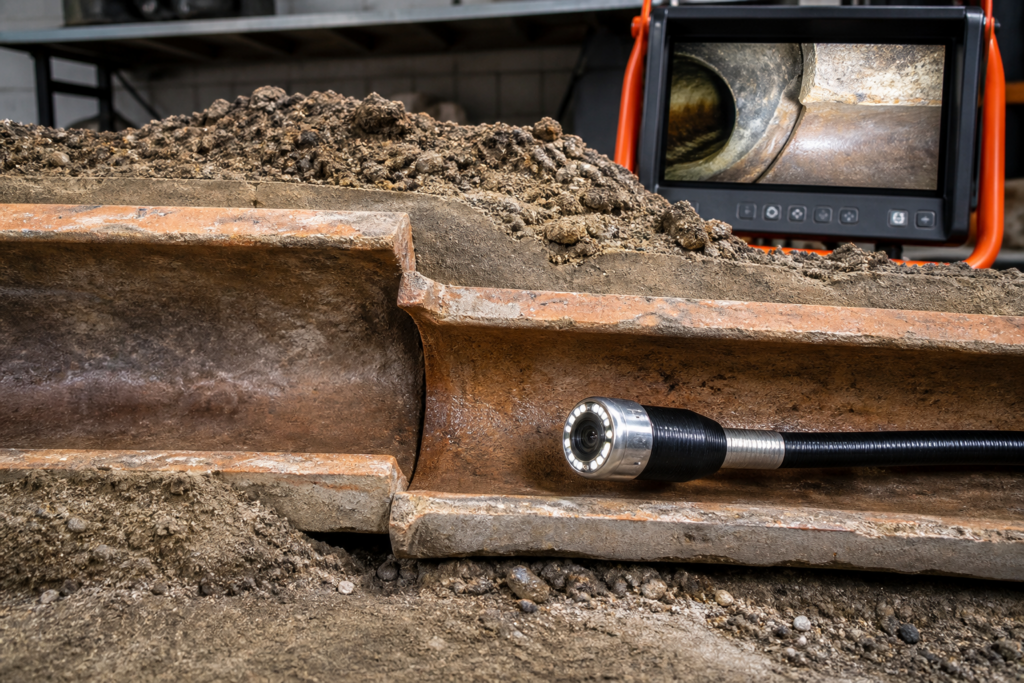




An offset sewer pipe joint means two connected pipe sections no longer meet in even alignment. On camera footage, the joint may look like a step, lip, or crescent-shaped ledge where one pipe opening sits partly to the side of the other. It may also show a gap, exposed joint edge, roots, or material caught at the transition.
An offset does not automatically mean the entire sewer line must be replaced. The decision depends on the remaining opening, joint condition, collected material, nearby pipe, and drainage history. A complete camera run and reliable location are needed before choosing monitoring or repair.
An Offset Is a Change in Alignment at a Joint
A sewer lateral is assembled from pipe sections and fittings. At a normal joint, the inside surfaces should create a reasonably continuous path for wastewater and solids. When one section shifts relative to the next, the inner edges no longer line up evenly.
The visible change can take several forms:
- A slight step with most of the pipe opening still clear
- A pronounced ledge that projects into the flow path
- An open separation or gap where roots or material can enter
- A reduced opening or joint edge that catches passing material
- Cracking, deformation, or missing pipe material beside the joint
A Traversable Joint Is Different From a Stopped Camera
The key fact in this situation is that the camera passed the joint and the inspection continued. That allows the plumber to compare the pipe before the offset, the transition itself, and the line beyond it. The complete run may show whether the condition is isolated or part of a wider pattern.
A camera that cannot pass a blockage creates a different evidence problem because the downstream pipe remains unseen. A traversable offset may still restrict flow or collect material, but it does not leave the same unknown section beyond an impassable camera head.
The camera’s ability to pass also does not prove that wastewater and solids move through the joint without interference. A compact camera head may clear a ledge that still catches paper, roots, or debris during normal use.
An Offset Joint Is Not the Same as a Sewer Belly
An offset is a discontinuity where connected pipe sections no longer align evenly. A sewer belly is a low or sagging length of pipe that loses consistent downhill grade and holds water. Either condition may appear during the same inspection, but one does not establish the other.
Standing water can obscure a joint, and a shifted joint may exist near a low section. The footage and location evidence should identify each finding separately. A repair recommendation for a joint should not be based only on water in the line, while a belly diagnosis should not be based only on a visible step at one connection.
What Complete Camera Footage Can Show
A useful recording should preserve more than one paused image. It should show the approach to the joint, the joint from a centered view when possible, camera passage through it, the downstream pipe, and a reverse view if that adds clarity. The recording may document:
- The visible pipe material and joint style
- The direction and shape of the alignment change
- Whether the usable opening is visibly reduced
- Whether roots, scale, paper, or debris collect at the edge
- Whether a gap or exposed joint surface is visible
- Whether cracking, deformation, corrosion, or another defect sits nearby
- Whether similar offsets appear elsewhere in the completed run
- Whether the joint looks clearer after suitable cleaning
A professional sewer camera inspection in Los Angeles can pair the footage with a distance reading and surface locating. That information helps connect the interior finding with the part of the property above it.
What Camera Footage Cannot Prove by Itself
A sewer camera views the inside of the pipe. It cannot directly show the condition of bedding or soil outside the line, the full shape of a void around the joint, or the exact reason the pipe moved. Settlement, poor original alignment, root activity, external loading, prior work, and changes around the pipe can produce overlapping interior appearances.
A camera near one wall can exaggerate the opposite edge. Water, residue, glare, or a tilted head can hide part of the opening. Distance readings can also shift with cable movement, so surface locating may be needed before planning access.
One frame also cannot establish how much pipe is affected. The plumber should review the surrounding footage instead of treating the sharpest image as the whole diagnosis.
Symptom History Changes the Decision
The same visible joint may lead to different recommendations depending on how the sewer has behaved. Useful history includes:
- Whether main-line backups have occurred and which fixtures were affected
- Whether restrictions return at the same located section after cleaning
- Whether roots or debris repeatedly appear at the joint
- Whether the home has had prior sewer repairs near that position
- Whether the joint looks unchanged or worse compared with older footage
- Whether nearby pipe shows other joints, cracks, corrosion, deformation, or poor grade
Symptoms are supporting evidence, not proof of cause. A backup can involve another restriction, and a home without a recent backup can still have a structural opening that deserves evaluation.
If wastewater is actively backing up into fixtures or onto a floor, stop using toilets, sinks, showers, laundry equipment, and dishwashers. Keep people and pets away from the affected water. Do not open a cleanout or insert equipment into the line.
Cleaning Can Improve the View but Cannot Realign the Joint
Roots, grease, scale, paper, or other removable material can make an offset look more obstructed than it is. When the pipe condition supports a suitable cleaning method, clearing that material may restore flow and allow a cleaner second camera view.
Cleaning does not move the pipe sections back into alignment, close an open separation, rebuild missing support, or seal a root-entry path. Repeated cleaning may manage material for a period, but it should not be described as a structural correction.
The choice between cleaning and repair should follow the pipe material, visible condition, location, symptoms, and full footage. A comparison of hydrojetting versus sewer-line repair can help clarify why removable buildup and displaced pipe require different decisions. Hydro jetting is not appropriate for every damaged line and should not be used simply to test whether a fragile joint will hold.
When Monitoring May Be Reasonable
Documented monitoring may be considered when the alignment change is slight, the opening remains largely usable, the camera passes without resistance, no open separation or root entry is visible, nearby pipe appears sound, and the service history does not show repeated trouble at that location.
Monitoring should have a clear baseline. Save the complete footage, note the location method, record the symptoms that prompted inspection, and identify what change would justify another evaluation. A quiet period alone does not prove the joint has stabilized, and a single camera angle is not enough to establish that it has worsened.
When a Focused Repair May Be Supported
A focused repair may be considered when one located joint creates a substantial ledge, reduces the usable opening, repeatedly catches material, admits roots, shows open separation, or sits beside cracking or other damage. The proposed work should identify the exact section and explain how correcting it restores a continuous, supported flow path.
Sewer line repair and replacement covers different methods, but no one method fits every offset. Pipe material, depth, access, utilities, surface conditions, neighboring pipe, and the reason for the displacement can affect the repair boundary. A trenchless method should not be promised before the joint and surrounding route are located and evaluated.
When a Broader Recommendation Needs More Evidence
One offset joint does not justify replacing an entire lateral. A broader recommendation should be supported by multiple located defects, widespread deterioration, repeated separations, collapse, extensive root entry, poor condition across a meaningful length, or another documented reason that a small repair would leave major problems in place.
Ask to see how the footage connects each affected section to the proposed scope. The recommendation should distinguish confirmed damage from sections that remain serviceable and from areas the camera did not evaluate clearly.
Questions to Ask About the Camera Finding
Ask these questions when reviewing the recording:
- Did the camera pass the joint and complete the intended run?
- Can I see the approach, the joint, and the pipe beyond it in the recording?
- Is the finding a small alignment change, a ledge, an open separation, or another condition?
- Does the joint reduce the usable opening or collect debris and roots?
- What pipe material and joint type are visible, and how was the joint located?
- Could water, residue, or camera angle be hiding part of the opening?
- Does surrounding footage show a belly, crack, deformation, corrosion, or more offsets?
- What exact evidence supports monitoring, a focused repair, or a broader recommendation?
Keep the complete video and any location notes, not only a screenshot. They provide a better baseline for another opinion or a later comparison.
Frequently Asked Questions
Is every offset sewer joint serious?
No. Visible offsets range from small alignment changes to deep ledges, open separations, and badly reduced openings. Severity depends on the usable opening, joint integrity, root or debris entry, surrounding pipe, location, and symptom history.
Can an offset be acceptable if the camera passes?
Camera passage is useful evidence, but it is not a complete flow test. The joint may still catch solids or roots. Review the full opening, surrounding footage, pipe condition, and service history before deciding to monitor it.
Can hydro jetting fix an offset joint?
No. Hydro jetting may remove suitable buildup or roots when the pipe can safely receive that service, but it does not realign separated pipe sections or close a structural gap. A second camera run may show the joint more clearly after removable material is gone.
Does an offset prove that the soil moved?
No. The interior image shows alignment, not the exterior support or the cause of movement. Surface locating, site conditions, prior work, and direct exposure during an approved repair may provide more evidence.
Does one offset mean the whole sewer line needs replacement?
Not by itself. A localized defect may support a focused repair, while several defects or widespread deterioration may justify a broader scope. The complete footage and location evidence should define the boundary.
Request a Camera-Footage Review in Los Angeles
An offset joint deserves a measured interpretation, not an automatic replacement decision. Preserve the full video, confirm that the camera passed the joint, keep the location record, and note any recurring symptoms or prior cleaning. A focused review can explain what the footage establishes, what remains unknown, and whether the evidence supports monitoring, a localized repair, or a wider sewer-line evaluation.