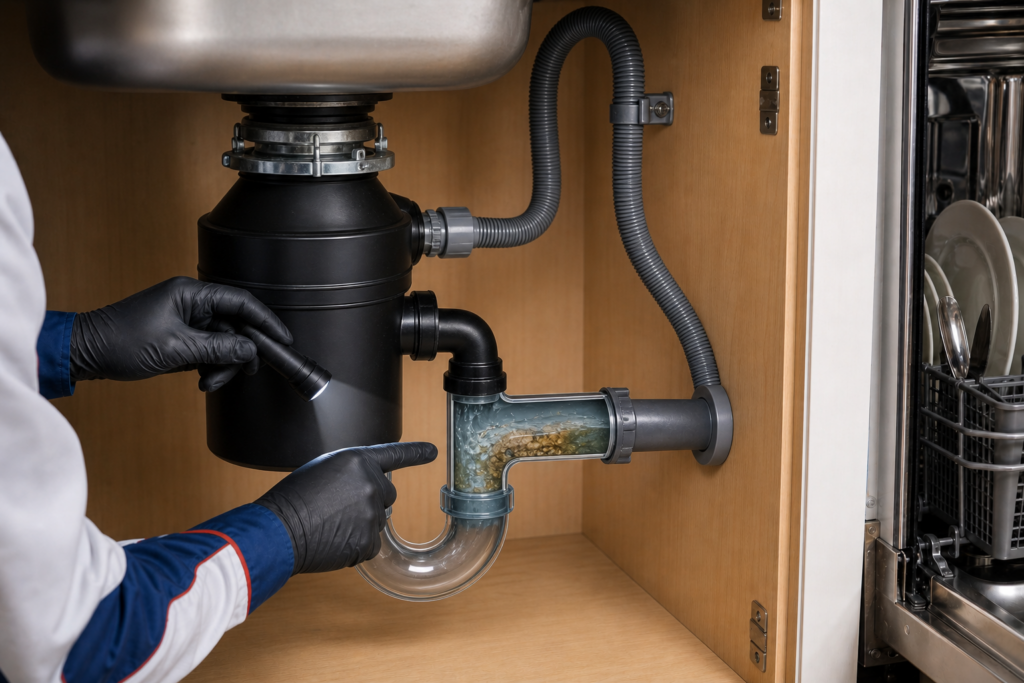




If water rises in your kitchen sink when the dishwasher pumps out, the dishwasher is sending wastewater into a drainage path that cannot carry it away quickly enough. A partial restriction downstream of the dishwasher connection is a common reason for this pattern. The restriction may be inside the garbage disposal, P-trap, trap arm, or kitchen branch drain.
The trigger does not prove where the problem is. A kinked dishwasher hose, clogged countertop air gap, obstructed disposal inlet, or deeper shared drain can create related symptoms. The location becomes clearer when you compare what happens during normal sink use, dishwasher discharge, disposal operation, and use of other nearby fixtures.
Stop running the dishwasher until the cause is understood. Repeated pump-out cycles can send more dirty water into the sink, cabinet, or countertop.
How Dishwasher Water Reaches the Kitchen Drain
A dishwasher does not usually drain through a completely separate pipe to the sewer. Its pump pushes wastewater through a discharge hose connected to the kitchen drainage system.
The exact arrangement varies. A dishwasher hose may rise to a countertop air gap before a second hose carries the water to a garbage disposal inlet or drain tailpiece. Another installation may use a secured high loop beneath the counter. From that connection, the water still has to pass through the disposal or tailpiece, P-trap, trap arm, and branch drain.
Dishwasher discharge arrives as a concentrated pumped flow. A sink may appear to drain acceptably under a light faucet stream while a partial buildup remains inside the branch. When the dishwasher adds water faster than the restricted pipe can move it, the easiest place for that water to appear may be the sink basin.
That difference explains why the symptom can seem appliance-specific even when the restriction is in the sink drain.
Signs of a Local Sink-Branch Restriction
A restriction downstream of the dishwasher connection becomes more likely when:
- The sink drains slowly during ordinary use.
- Water rises in the sink within seconds of the dishwasher pump starting.
- The sink gurgles as the dishwasher discharges.
- The water eventually drains after the dishwasher stops.
- Both sink basins are affected.
- The disposal drains slowly even though its motor sounds normal.
- The symptom returns after grease, food residue, or other debris enters the kitchen drain.
The buildup may be in the disposal chamber, P-trap, short trap arm, or branch farther inside the wall. The timing alone cannot identify which section is affected.
A Los Angeles plumber may reproduce the symptom carefully, inspect the connections, and determine which part of the branch needs attention. Papa’s Plumbing provides drain cleaning in Los Angeles for kitchen sinks and other affected drains.
When the Dishwasher Hose Is More Likely
A blocked, kinked, or poorly routed dishwasher hose more often causes water to remain inside the dishwasher than water to rise in the sink. You may notice standing water at the bottom of the appliance, an incomplete drain cycle, an appliance error, or only a weak amount of discharge reaching the sink connection.
Look only at the visible hose route beneath the sink. A sharp bend, crushed section, loose connection, or active leak is useful information. Do not disconnect a hose while the dishwasher or sink contains water. Opening the connection can release hot, dirty water into the cabinet.
If the dishwasher retains water but the sink drains normally under a strong faucet flow, the appliance hose, pump, filter, or connection deserves attention. Appliance instructions and a qualified diagnosis should determine the next step.
What Water at the Countertop Air Gap Means
Some kitchens have a small cylindrical air-gap fitting beside the faucet. During normal discharge, dishwasher water passes through the air-gap assembly and continues through a larger hose toward the disposal or sink drain.
Water spilling from the air-gap cap can indicate that the downstream air-gap hose, disposal inlet, or connected drain is not accepting the dishwasher flow. Debris inside the removable cap area can also interfere with discharge.
If the appliance instructions permit it, you may lift only the removable outer cap and look for visible debris after the dishwasher is off and the area has cooled. Do not force a tool into the fitting, disconnect the under-sink hoses, or run another dishwasher cycle while the sink is full. Water that continues to escape from the air gap needs a closer inspection of the complete discharge path.
Not every dishwasher installation uses a visible countertop air gap. The absence of one does not establish that the plumbing is wrong.
How the Garbage Disposal Connection Can Affect Drainage
When a dishwasher connects to a garbage disposal, its discharge hose enters through a side inlet. Water then moves through the disposal chamber before joining the sink drain.
A food-packed disposal chamber or restriction immediately below it can make dishwasher water rise into the sink. The sink may also drain slowly during normal use. If the disposal hums, stalls, leaks, or trips its reset, stop using it. Turn off its electrical power before anyone inspects the unit, and never place a hand inside the grinding chamber.
A different condition can occur after a disposal replacement. The dishwasher inlet has a removable internal knockout that must be opened when that connection is used. If it remains closed, the dishwasher generally cannot discharge into the disposal. That possibility is most relevant when the symptom began immediately after a new disposal was installed; it should not be assumed from a sink backup alone.
Papa’s Plumbing also handles sink and garbage-disposal service when the fixture or disposal itself contributes to the problem.
Clues That the Restriction Is Deeper Than the Kitchen
A kitchen-only branch problem usually stays limited to the sink, dishwasher, and disposal. A deeper shared-drain or sewer problem may affect other fixtures.
Watch for:
- A nearby floor drain, tub, or shower reacting when the dishwasher or sink drains.
- More than one fixture becoming slow at the same time.
- A toilet gurgling when kitchen water is released.
- Dirty water appearing at a lower drain.
- Recurring backups after the kitchen branch was previously cleared.
- Wastewater odor accompanying a multi-fixture backup.
- Similar symptoms in another unit of a multi-unit property.
Stop water use when several fixtures are involved or wastewater is entering a living area. Keep children and pets away from the affected water. In a rental or multi-unit building, notify the property manager because the affected piping may serve more than one unit.
A sewer camera inspection may be considered when symptoms and accessible pipe size point to a deeper recurring problem, but a camera is not automatically the first or appropriate tool for every kitchen branch.
Safe Steps to Take Right Away
Use these steps to limit another backup and give the plumber useful information:
1. **Stop the dishwasher.** Pause or turn it off using its normal controls. Do not select another drain or pump-out cycle while the sink is full.
2. **Stop adding water.** Do not run the faucet, disposal, or another appliance connected to the same branch.
3. **Protect the cabinet and floor.** Place towels around the cabinet base if water is near the rim or leaking from a connection. Avoid contact with dirty water and wash exposed skin promptly.
4. **Check for an active leak without touching fittings.** Look under the sink for water at the hose connection, air-gap hose, disposal, P-trap, and wall connection. Do not tighten or remove parts while the basin contains water.
5. **Note where the water appears.** Record whether it rises in one basin or both, spills from the air gap, remains in the dishwasher, or appears at another fixture.
6. **Listen without repeatedly testing.** A gurgle, disposal hum, or weak dishwasher pump-out can help separate possibilities. One observed event is enough; repeated cycles add water without improving the diagnosis.
7. **Keep electrical equipment dry.** If water reaches the disposal wiring, outlet, dishwasher connection, or another electrical component, do not touch the equipment. Shut off the appropriate circuit only if you can do so safely from a dry location.
8. **Arrange service if the backup persists or returns.** A partial restriction may drain slowly after the pump stops without being clear.
These observations are safer and more useful than taking apart a full trap or forcing tools into an unknown blockage.
What Not to Do With a Backed-Up Dishwasher Drain
Do not pour chemical drain cleaner into the sink. The product can remain trapped in standing water, move toward an appliance connection, splash when the dishwasher pumps, or expose the next person who opens the drain.
Avoid pouring boiling water into a full sink or disposal. It creates a scald risk and does not identify whether the obstruction is grease, food debris, a damaged component, or a deeper restriction.
Do not remove a P-trap while the sink contains water. The basin and dishwasher connection can release much more water than a small container can hold.
Do not reach inside the garbage disposal, even when it appears off. Do not insert a wire, improvised tool, or household drain snake through the dishwasher connection.
Do not keep plunging when you do not know how the dishwasher hose and air gap are connected. Pressure can redirect dirty water toward the appliance, air gap, or cabinet. General sink-clog methods should be used only when the plumbing arrangement and safety conditions support them. Papa’s Plumbing has separate information about handling a kitchen-sink clog without harsh chemicals, but standing wastewater and an appliance-triggered backup call for additional caution.
How a Plumber Narrows the Cause
A useful diagnosis starts with the sequence of symptoms rather than assuming every dishwasher-triggered backup needs the same treatment.
The plumber may check:
- Whether the sink drains normally without dishwasher discharge.
- Whether the dishwasher empties completely.
- Whether water escapes from the countertop air gap.
- Whether the discharge hose is kinked, leaking, or improperly connected.
- Whether the disposal accepts sink water and dishwasher water.
- Whether the P-trap and trap arm are restricted.
- Whether other fixtures point to a deeper shared drain.
- Whether prior clearing produced only temporary improvement.
The appropriate cleaning method depends on the affected pipe, access, material, condition, and type of obstruction found. A local branch restriction may call for targeted drain cleaning. Recurring or multi-fixture symptoms may justify examining a deeper section. An appliance-side failure may need dishwasher service rather than more work on a clear drain.
The goal is to identify the section that cannot carry the discharge before choosing equipment or replacing a component.
When to Request Drain Service
Arrange professional help when:
- The sink backs up during every dishwasher cycle.
- The sink remains full after the dishwasher stops.
- Dirty water spills from the air gap or leaks into the cabinet.
- The disposal hums, stalls, leaks, or has no power.
- The dishwasher retains water and the hose route is not visibly kinked.
- Chemical cleaner has already been added.
- More than one fixture is slow, gurgling, or backing up.
- The symptom returns after a previous clearing.
- Wastewater reaches flooring, cabinets, electrical connections, or another living area.
A sink that eventually drains is not necessarily clear. Partial restrictions often allow slow drainage between appliance cycles and then reappear under a stronger discharge.
Reduce the Chance of Another Kitchen Backup
Keep cooking grease and oil out of the sink. Use a basket strainer to catch food scraps, and avoid loading fibrous, starchy, or hard waste into the disposal. Follow the dishwasher and disposal manufacturers’ cleaning and operating instructions.
Pay attention to early changes. A sink that drains more slowly, gurgles after dishwasher use, or develops repeated odor deserves attention before water rises over the rim.
Do not use routine chemical treatments as a substitute for identifying a recurring restriction. If the same symptom returns, describe its exact trigger and timing when requesting service.
Get Help With a Dishwasher-Triggered Sink Backup in Los Angeles
If your kitchen sink rises, gurgles, or backs up when the dishwasher drains, stop both fixtures and let Papa’s Plumbing inspect the connected drainage path. A condition-led diagnosis can distinguish an appliance hose or air-gap issue from a disposal, P-trap, kitchen branch, or deeper shared-drain restriction.
Contact Papa’s Plumbing and describe whether the sink drains normally at other times, whether the dishwasher retains water, whether the air gap spills, and whether any other fixtures react. Those details help narrow the safest next step.