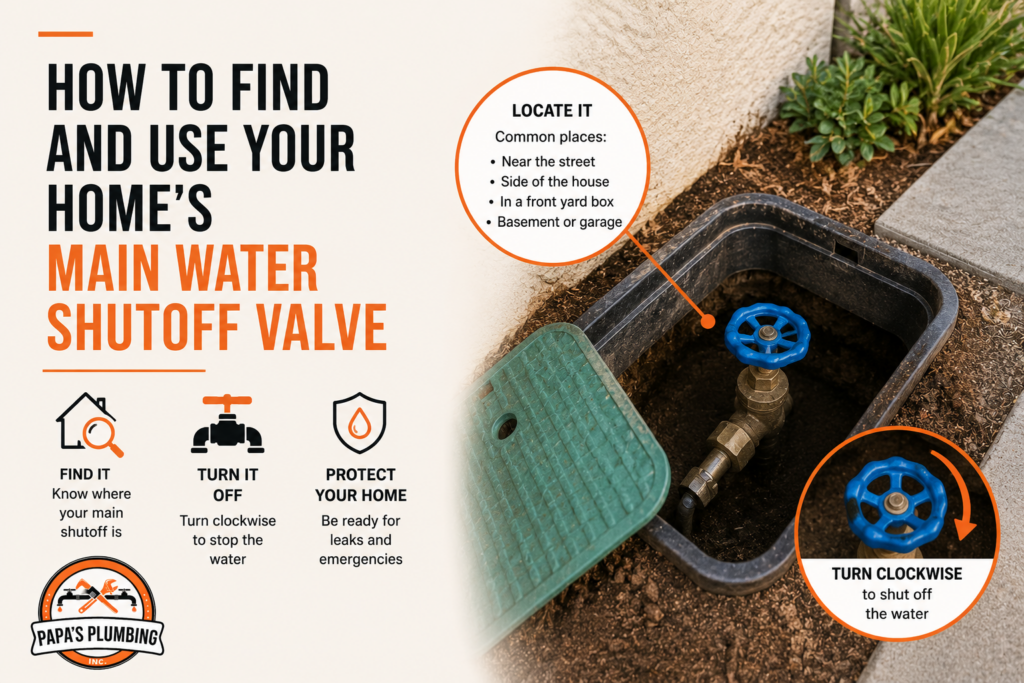




The single most important thing every Los Angeles homeowner can know about their plumbing is where the main water shutoff valve is and how to turn it off. Not in five minutes when water is pouring through a ceiling. Not next week when you finally get around to it. Right now, while everything is calm and you have time to look.
Most homeowners learn the location of their shutoff valve during a plumbing emergency, which is exactly the wrong time to be searching. Water from a burst pipe or a failed supply line floods a home at roughly 4 to 12 gallons per minute. That is 240 to 720 gallons in the first hour. Knowing where to go and what to do can reduce a $30,000 insurance claim to a $300 repair bill.
Here is how to find your main water shutoff valve, how to operate it, and what every homeowner should check before the emergency happens.
What a Main Water Shutoff Valve Actually Does
Your home has one valve that controls all incoming water from the municipal supply. Turn it off and every fixture in the house loses water within a few seconds. Toilets stop refilling, faucets run dry, the dishwasher and washing machine cannot fill, and the water heater stops drawing make-up water. The only water left in the home is whatever is already in the pipes between the valve and your fixtures, which drains out quickly when you open a low fixture.
This is the valve you want during any plumbing emergency: a burst pipe, a leaking water heater, a fixture supply line that has failed and is spraying water under a sink, a toilet supply line break, or any other failure where water is escaping faster than you can contain it.
Where to Find Your Main Water Shutoff Valve in an LA Home
The location depends on when and how your home was built. Here are the most common locations in Los Angeles homes, in order of likelihood.
- On an exterior wall closest to the street: For homes built between roughly 1950 and 2000, the main shutoff is often on an exterior wall facing the street, usually within a few feet of where the water service pipe enters the home. Look for a brass valve with a round handle (older gate valves) or a lever handle (newer ball valves) attached to a copper or galvanized pipe coming through the wall or up from the ground.
- In the garage near the front of the property: Many post-1970 homes route the main supply through the garage. The valve is usually mounted on an interior garage wall, sometimes within a small access panel.
- In a basement near the foundation wall: For older homes with full basements, look along the foundation wall facing the street. The valve is typically within 4 to 6 feet of where the supply pipe comes through the wall.
- In a crawlspace: Many older LA homes have crawlspaces rather than basements. The shutoff may be located inside the crawlspace at the point where the supply pipe enters the home. This is the worst-case location for emergencies because access requires getting under the home. If your valve is here, consider having a plumber add a second accessible shutoff valve inside the home or just outside the crawlspace entry.
- In a utility closet or laundry room: Some homes route the main line through an interior utility area before distributing to the rest of the house. The valve is often mounted on the wall near where the water heater is installed.
- In a wall-mounted access box on the exterior: Some newer construction and major remodels include a labeled exterior access box specifically for the main shutoff. Look for a small metal door near the front of the property, often labeled “Water” or “Main Shutoff.”
The Curb Stop: Your Backup Shutoff at the Street
If you cannot find a main shutoff inside or attached to your home, every property in Los Angeles also has a “curb stop” valve located at the street, typically inside a small underground concrete or metal box near the public sidewalk or in the parkway strip between the sidewalk and the curb. This is technically owned by LADWP or your water utility, but homeowners can operate it in emergencies if no other shutoff exists.
The curb stop is located inside a rectangular metal access cover usually 10 to 14 inches long and 6 to 8 inches wide, set flush with the ground. Lifting the cover reveals a valve operated by a long-handled wrench called a “curb key” or “water meter key.” Standard wrenches and pliers will not turn it.
If you do not have any accessible main shutoff inside your home, two things are worth doing this week:
- Locate your curb stop and verify the cover lifts (it can rust shut if never operated).
- Buy a curb key at any home improvement store. They cost $15 to $40 and are the only tool that operates the curb stop valve. Store it somewhere accessible, not buried in the back of a garage.
How to Turn Off Your Main Water Shutoff
The two valve types you will encounter both turn off, but they operate differently.
Ball valve (lever handle): Modern shutoff valves use a lever handle that is parallel to the pipe when open and perpendicular to the pipe when closed. Rotate the lever 90 degrees in either direction until it is at a right angle to the pipe. Water is now off. Ball valves are the easiest to operate and the most reliable for emergencies. If your home has one of these, you are in good shape.
Gate valve (round handle): Older homes typically have a round handle that resembles a small spoked wheel. Turn it clockwise to close, counterclockwise to open. Gate valves require multiple full rotations to fully close, often six to twelve turns depending on the valve. They are also prone to seizing if not exercised regularly, which is the next section.
Why You Should Exercise Your Valve Once a Year
Gate valves in particular develop a problem called “frozen handle” if they are left untouched for years. Mineral deposits and corrosion bond the internal valve components together, and when you finally need to turn the handle in an emergency, it either will not move at all or it breaks off in your hand. Both outcomes are bad.
The fix is simple. Once a year, turn your main shutoff valve fully off and then fully back on. Just one cycle, slowly and gently. This breaks up any mineral buildup, keeps the valve components moving freely, and confirms the valve actually works before you need it. If the valve resists, leaks when operated, or will not fully close, call a plumber and have it replaced. Replacement of a single shutoff valve is a quick and inexpensive job. Discovering a failed shutoff during a 2 a.m. emergency is not.
Pick a date that you will remember. New Year’s Day, the start of daylight saving time, your home’s anniversary, or any other annual marker. Many homeowners pair it with smoke detector battery replacement so the maintenance happens together.
What to Do Immediately After Shutting Off the Water
Once the main water is off, you have stopped the flow but you have not yet finished managing the emergency. Five things to check or do in the first few minutes:
- Open a low fixture to drain residual water from the pipes: Turn on a faucet at the lowest level of the home (a basement utility sink, a first-floor hose bib, or the lowest bathroom). This drains residual water from the supply lines and stops continued dripping from the failed location upstairs.
- Turn off the water heater: If you have a tank water heater, shut off the gas (on gas units) or flip the breaker (on electric units). With no incoming water, a heating water heater can overheat and damage the tank. For gas units, find the gas valve at the base of the unit and turn it to “off” or “pilot.” For electric units, find the breaker labeled “water heater” in your main electrical panel and switch it off.
- Document the damage with photos before cleanup: Take pictures of the failed component, any standing water, and any visible damage to walls, ceilings, floors, or contents. Insurance claims go more smoothly with timestamped documentation from the moment of discovery.
- Move valuables and electronics out of the affected area: Water continues to spread and seep into surfaces for hours after the initial event. Anything important and movable should be relocated to a dry area.
- Call a licensed plumber: With the water off, you have time to make a careful call rather than panicking. A plumber can diagnose the failure, give you a quote for the repair, and help you decide whether to also bring in a water damage restoration company for the cleanup.
Individual Fixture Shutoffs: A Faster First Response
For failures at a specific fixture (under-sink supply line, toilet supply line, washing machine hose), you do not necessarily need to shut off the whole house. Every fixture in your home should have its own local shutoff valve, typically located:
- Under sinks: Look under the cabinet for two small valves (hot and cold) on the supply lines feeding the faucet. Turn the valve handles clockwise to close.
- Behind toilets: A single valve sits on the wall behind or beside the toilet on the supply line. Same clockwise-to-close direction.
- Behind washing machines: Two valves (hot and cold) behind or above the machine. Often combined into a single dual-handle valve box mounted on the wall.
- At the water heater: A valve on the cold water supply line at the top of the heater. Closing this isolates the water heater from the rest of the home.
If the failure is contained to one fixture, using the local shutoff lets the rest of the home keep water service. For larger failures or anything you cannot quickly isolate, the main shutoff is the right move.
What to Do If Your Shutoff Valves Are Inaccessible or Failing
Some LA homes have shutoff valves in genuinely terrible locations: behind walls that were closed up during a remodel, inside crawlspaces with locked access panels, or attached to seized supply lines that will leak if disturbed. Other homes have shutoffs that are technically present but no longer functional because they were never exercised and have failed internally.
If your home falls into either category, the right time to address it is during normal business hours, not during an emergency. A plumber can install a new accessible main shutoff valve in a logical location, replace failed individual fixture shutoffs, and ensure that every water supply path in your home has a working isolation valve. The cost is modest and the clear expectations is significant.
For older Los Angeles homes that are still on original 1920s or 1930s plumbing, valve replacement is often handled as part of a broader plumbing modernization that includes water line repair or repipe work. Adding accessible shutoffs is a small addition to that scope.
The Five Minutes That Save Your Home
Take five minutes today. Walk to where you think your main water shutoff is. Confirm you can reach it. Confirm the handle turns. If you cannot find it, look in the other locations listed above. If you find it but cannot turn it, call a plumber to fix it before you need it.
This is the single highest-return plumbing knowledge any homeowner can have. The investment is a few minutes of attention. The payoff is the difference between a contained inconvenience and a flooded home.
Papa’s Plumbing Inc. is a third-generation family-owned plumber serving Los Angeles since 2015. If you cannot locate your main water shutoff, your valve is seized or leaking, or you want a plumber to walk through your home and identify every accessible shutoff point, we are happy to do that as part of a routine plumbing inspection. Call (626) 243-3689 or schedule a plumbing inspection across LA, Glendale, Pasadena, Encino, La Cañada Flintridge, and the surrounding communities.