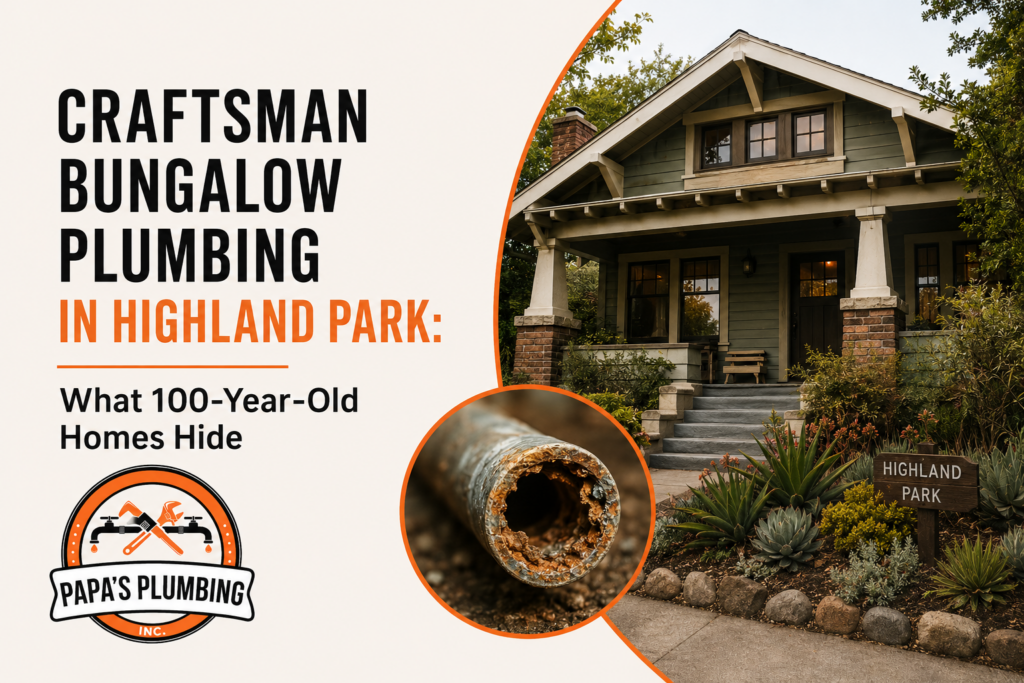




Highland Park is one of Los Angeles’s oldest residential neighborhoods, with most of its housing stock built between 1900 and 1930 during the height of the California Arts and Crafts movement. The tree-lined streets between Avenue 50 and Avenue 64 are filled with original Craftsman bungalows, Victorian cottages, and Spanish Revival homes that have survived a century of LA history.
What they have not survived gracefully is a century of plumbing. If you own a pre-1930 home in Highland Park, the plumbing inside your walls was specialized when Calvin Coolidge was president. It is now at or past the end of its design life, and it is hiding problems that almost always surface in the worst possible way: during a remodel, during escrow, or at 2 a.m. on a Sunday.
Here is what a 100-year-old Highland Park bungalow typically hides, why it matters now, and what to do about it before the problems force the conversation.
The Three Pipe Materials Hiding in Your Highland Park Bungalow
Almost every original Highland Park home built before 1930 has the same three plumbing materials still in service today. Each one is at or past its expected life.
Galvanized steel water supply lines. Galvanized was the standard for residential water supply from roughly 1880 through the late 1950s. Original spec was a 50-year service life. Highland Park bungalows installed between 1910 and 1930 are now running on supply lines that are 95 to 115 years old. The zinc coating that was supposed to protect the steel dissolved decades ago, and the steel underneath has been corroding from the inside ever since. Interior pipe diameter that started at 3/4 inch is now often choked down to less than 1/4 inch by accumulated rust scale.
Cast iron drain stacks and horizontal runs. Cast iron was the standard for residential drain systems through roughly 1970. Original spec was 50 to 75 years. Highland Park’s pre-1930 cast iron drains are now 95 to 115 years old. Cast iron does not rust evenly. It develops a failure mode called “channeling” where the bottom of horizontal pipe runs wears through while the top still looks fine from a visual inspection. Channeled cast iron eventually develops cracks, then sewer leaks behind walls or under floors that are often only discovered when mold or wood rot surfaces.
Vitrified clay sewer laterals. The pipe running from your home to the city sewer main on the street is almost certainly clay if your home was built before 1970. Clay is durable in compression but brittle at the joints, which is exactly where roots from Highland Park’s mature street trees invade. Recurring main line clogs, slow drainage in multiple fixtures, and sewer smells in the yard or crawlspace are the warning signs of clay lateral failure.
The Warning Signs Your Highland Park Bungalow Plumbing Is Failing
You do not need to open walls to know whether your Highland Park home is showing pre-failure symptoms. The signs are visible from inside the living space if you know what to look for.
- Low water pressure throughout the home: Galvanized supply lines that have been corroding for a century have interior diameters reduced to a fraction of original. If running one fixture noticeably drops pressure at another, your supply system is choked.
- Brown or rust-colored water on first draw: The first few seconds of water from a tap that has been idle overnight should run clear. If it runs orange, brown, or rust-tinted, your supply pipes are shedding corroded interior into your drinking water.
- Slow drains in multiple fixtures simultaneously: A single slow drain is usually a local clog. When the kitchen sink, the bathroom drain, and the laundry standpipe are all slow at the same time, the problem is downstream in the main drain stack or the sewer lateral.
- Sewer smell in cabinet bases or closets: Cast iron drain stacks that have channeled and cracked leak sewer gas (and sometimes liquid sewage) into wall and floor cavities. The smell usually surfaces in cabinets, closets, or rooms adjacent to a bathroom.
- Recurring main line clogs needing repeated snaking: If a plumber has been out to snake your main line more than once in the past year, the snake is treating a symptom. Roots in the clay lateral are growing back faster than auger work can clear them.
- Bathroom tile or ceiling staining below an upstairs bath: Active leaks from second-floor bathroom drains often surface as discoloration on first-floor ceilings or upper sections of walls. By the time you can see it, the leak has been working for months.
- Mildew or musty smell in closets sharing a wall with a bathroom or kitchen: Slow weeping leaks from supply lines or drain pipes inside walls create constant moisture that favors mold growth. If a closet smells off even after cleaning, the wall behind it may be staying wet.
Why Highland Park Plumbing Problems Compound Faster Than Other LA Neighborhoods
Two factors specific to Highland Park accelerate plumbing deterioration compared to LA averages.
The age concentration of housing: Most LA neighborhoods have housing spread across multiple decades. Highland Park’s housing is concentrated heavily in a 30-year window from roughly 1900 to 1930. That means the entire plumbing infrastructure across the neighborhood is aging simultaneously. The original galvanized, cast iron, and clay components installed during the Arts and Crafts era are all reaching the end of their design lives within the same decade. The problems are not random failures, they are predictable, age-driven, neighborhood-wide.
LADWP water hardness: Highland Park is served by LADWP, drawing from a blend of Owens Valley aqueduct water and Metropolitan Water District imports. The mineral content is high enough to accelerate scale buildup inside both galvanized supply pipe and tank water heaters. The same hard water that has been depositing mineral scale on your faucet aerators for the past 50 years has been doing the same thing inside the pipe walls.
HPOZ Permitting: What Highland Park Homeowners Need to Know
A significant portion of Highland Park sits within the Highland Park-Garvanza Historic Preservation Overlay Zone (HPOZ), one of the largest HPOZs in Los Angeles. The HPOZ adds review requirements for any visible exterior plumbing work, including water service line replacement that affects front yards, sewer cleanout installation, and any equipment visible from the street.
What this means in practical terms: you cannot simply have a plumber show up, dig a trench across your front yard, and install new water service. The work needs to be reviewed by the HPOZ board, the permit needs to reflect that review, and the visible restoration needs to match the original character of the property. Interior plumbing work (like a repipe that does not affect exterior visibility) generally does not trigger HPOZ review, but every Highland Park homeowner should verify with their plumber that any visible exterior work will be coordinated properly.
This is why working with a plumber familiar with Highland Park specifically matters. Out-of-area plumbers regularly underestimate the HPOZ review timeline and pull permits incorrectly, which leads to stop-work orders, delayed projects, and unexpected costs.
What a Highland Park Bungalow Plumbing Overhaul Actually Looks Like
Most Highland Park bungalows in active failure stage need three things, ideally coordinated together:
- A whole-home repipe to replace galvanized supply lines with copper and PEX. Three to five working days for a typical bungalow, with minimal wall opening if planned carefully.
- Cast iron drain stack replacement for any horizontal drain runs and vertical stacks showing channeling or cracking. Often coordinated during the repipe so walls only get opened once.
- Sewer lateral repair or replacement if camera inspection shows root intrusion, cracks, or collapsed sections. Modern trenchless methods (pipe bursting or CIPP lining) can replace the lateral without trenching across your front yard, which is especially valuable in HPOZ areas where surface disruption requires more review.
Doing all three together costs noticeably less than doing them as separate projects spread across years, because the labor, permitting, and access work overlaps substantially. For Highland Park homeowners planning a renovation anyway, the time to address the plumbing is during the same project window. Walls are already open, the contractor is already onsite, and the plumbing work can be integrated into the broader scope.
Pre-Purchase Inspection: What Highland Park Buyers Should Demand
If you are buying a Highland Park home built before 1940, a standard home inspection will not tell you the condition of the plumbing inside the walls. Standard inspectors look at visible fixtures and turn on faucets. They do not run sewer cameras, they do not test water pressure formally, and they do not evaluate galvanized pipe interior condition.
For any Highland Park home older than 75 years, two add-on inspections are worth the cost during your contingency period:
- A sewer camera inspection of the lateral from the cleanout to the city main, documenting any roots, cracks, bellies, or collapsed sections.
- A pressure test and supply line evaluation at multiple fixtures, with the plumber noting whether visible supply pipe is galvanized and what condition it is in at the meter and at exposed access points.
The results of these inspections give you real numbers for negotiation. A documented need for a full repipe or sewer replacement is a legitimate price reduction or credit at closing. Without the inspections, you inherit those problems at full price.
Get a Plumber Who Knows Highland Park’s 100-Year-Old Homes
If you own a Highland Park bungalow and you are seeing the warning signs in this article, the right next step is a plumbing inspection with a licensed plumber familiar with this neighborhood specifically. Pre-1930 homes have plumbing realities that newer plumbers regularly misdiagnose, and HPOZ work requires coordination that out-of-area contractors rarely handle correctly.
Papa’s Plumbing Inc. is a third-generation family-owned plumber serving Los Angeles since 2015. We have repiped Craftsman bungalows across Highland Park, replaced cast iron drain stacks in pre-1930 homes throughout NELA, and trenchlessly replaced clay laterals in Highland Park-Garvanza HPOZ-designated properties. Whether you need a sewer camera inspection before closing on a property, a whole-home repipe on a bungalow you already own, or a sewer line replacement on a clay lateral that has finally given up, we have done it in this neighborhood and we can do it for your home.
Call (626) 243-3689 or request a Highland Park plumbing inspection.