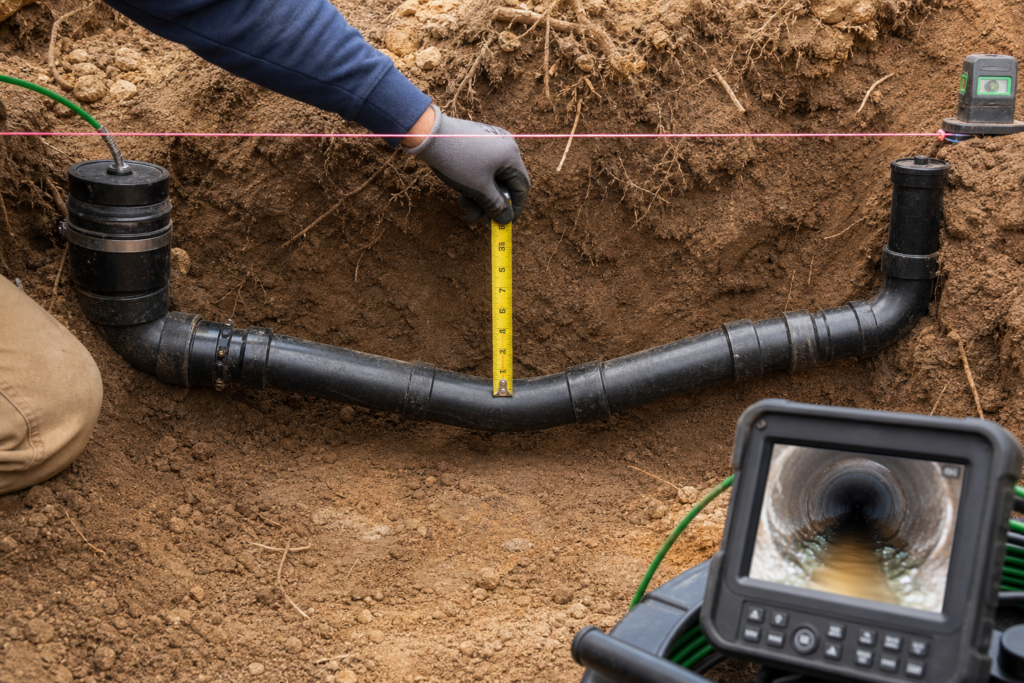




A sewer-line belly is a low or sagging section of pipe where wastewater cannot keep moving downhill as intended. Water and solids can collect in that dip, restrict the usable opening, and contribute to backups that return after the line has been cleared. Cleaning may restore flow for a while, but it does not lift the pipe or correct its slope.
Recurring backups do not automatically prove that a belly exists. Roots, grease, scale, an offset joint, a damaged pipe, or material left in the line can cause similar symptoms. A plumber needs current inspection findings and location measurements before recommending a structural repair.
Why Sewer Lines Need a Consistent Downhill Grade
A building sewer depends on gravity. The pipe needs a suitable, continuous slope so wastewater carries solids toward the public sewer or septic connection. A section that drops and then rises creates a low point. Liquid can remain there after each discharge instead of draining away.
The retained water reduces the open space inside the pipe. Paper and waste moving through the line can slow down, settle, or collect at the transition where the pipe begins climbing out of the low section. The next heavy discharge may push some material through, but the condition remains. Over time, the line may become restricted again.
The depth or appearance of the dip alone does not determine the repair. The important questions are how much flow is being interrupted, what material is collecting, how often problems return, and whether the surrounding pipe is otherwise sound.
How a Sewer-Line Belly Can Form
Several conditions can change the support or grade beneath a buried sewer lateral:
- Soil may settle after construction, excavation, heavy rain, or long-term erosion.
- Bedding under the pipe may have been uneven, poorly compacted, or washed away.
- A long pipe run may not have enough support between stable points.
- A repair section may have been installed at the wrong elevation or connected to piping that already had poor grade.
- Ground movement can shift joints or create a low area without fully breaking the pipe.
- Nearby root growth or other site conditions can disturb the soil around the line.
Age alone does not confirm a belly. A newer line can lose support, while an older line may still maintain proper grade. The pipe material also does not answer the question by itself. The route, soil, installation, joints, and changes around the property all matter.
Warning Patterns That Deserve Investigation
A belly can produce the same warning signs as a clog, so symptoms are a reason to investigate rather than a diagnosis. Arrange an evaluation when you notice:
- A main-line backup returns after professional clearing.
- Several fixtures slow or gurgle at the same time.
- Water rises in a shower, tub, or floor drain when a toilet flushes.
- Wastewater backs up at the lowest drain in the home.
- A prior camera inspection showed standing water in the same section.
- The line repeatedly collects paper or debris at a known location.
One slow sink or shower is more likely to involve a local branch drain. A problem that affects several fixtures may involve a shared drain or the main sewer line. If wastewater is actively backing up, stop using toilets, sinks, showers, washing machines, and dishwashers. Keep people and pets away from contaminated water and call a plumber. Do not remove a cleanout cap or attempt to open a pressurized blockage.
Why Snaking or Hydro Jetting May Only Provide Temporary Relief
Drain cleaning removes or breaks through material that is restricting flow. A cable machine may open a path through a blockage. Hydro jetting may remove grease, scale, and other suitable buildup when the pipe is in condition for that service. Either method can be useful when removable material is the cause.
Neither method changes the elevation of a buried pipe. If solids collect because the line drops and rises, cleaning can empty the low section without restoring the missing grade. The line may work normally immediately after service and then begin retaining material again.
That does not mean every clog that returns requires excavation. The first cleaning may not have removed the complete blockage, roots may be re-entering through a damaged joint, or another defect may be involved. The condition should be documented after the line is clear enough to inspect rather than choosing a repair from symptoms alone.
What a Sewer Camera Can Show
A professional sewer-camera inspection can show standing water, accumulated debris, separated or offset joints, cracks, root entry, changes in pipe material, and other visible conditions. When the camera passes through a low section, the lens may enter water and then emerge as the pipe rises again. Repeating that pattern at the same located section is useful evidence.
Camera footage has limits. Water can hide the bottom of the pipe, and the image alone may not provide exact depth, length, or slope. A plumber may need to clear the line, locate the camera head from the surface, mark the affected section, compare entry and exit elevations, and take site measurements. Those steps help distinguish a true loss of grade from an obstruction that merely caused water to stand temporarily.
A useful diagnosis should identify:
- Where the low section begins and ends.
- Whether the pipe is intact, cracked, offset, or collapsed.
- What material is collecting in the area.
- Whether the surrounding line has adequate grade.
- What surfaces, structures, utilities, or landscaping are above the affected section.
That evidence allows the repair to target the failed section instead of replacing or cleaning pipe by guesswork.
When Repair or Replacement May Be Needed
If measurements confirm that a pipe section has lost grade and is causing repeated restrictions, the dependable correction usually requires restoring a continuous downhill path. Depending on access and pipe condition, that may involve exposing the affected section, rebuilding suitable support, setting the pipe at the correct elevation, and replacing damaged or poorly graded piping.
The repair boundary should extend far enough to connect to stable pipe at workable elevations. Replacing only the deepest point without correcting the approach and exit can leave another poor transition. The plumber also needs to account for required connections, cleanouts, nearby utilities, property access, and local permit or inspection requirements.
Pipe lining can seal certain cracks or damaged surfaces, but a liner follows the existing route. It does not raise a sunken section or create missing slope by itself. Other trenchless methods may be appropriate for some replacement projects, but the available elevations and site conditions still have to support proper grade. A method should be chosen after the low section is located and measured.
Questions to Ask Before Approving Sewer-Line Work
Clear findings make it easier to compare recommendations. Ask the plumber:
- Where is the suspected belly, and how was it located?
- Does the footage show standing water after the line has been cleaned?
- Were the pipe elevations or grade checked from the surface?
- Is there also a crack, offset joint, root opening, or collapse?
- Could removable buildup explain the symptoms instead?
- What section must be corrected to create continuous drainage?
- Will the proposed method restore grade or only address the pipe wall?
- What surfaces will need access, and how will the repair be tested afterward?
The answers should connect the observed condition to the proposed work. A recommendation based only on repeated clogs, without current inspection or location evidence, leaves too much uncertainty.
Schedule a Sewer-Line Evaluation in Glendale
If your Glendale home has main-line backups that return after cleaning, contact Papa’s Plumbing Inc. for an evidence-based evaluation. The plumbing team can inspect and locate the affected sewer section, explain whether the problem is removable buildup or a structural loss of grade, and discuss an appropriate repair when the pipe cannot drain reliably.