



California homeowners spend a lot of time thinking about earthquake preparedness in terms of supplies: water, food, flashlights, first aid kits. Far fewer think about the plumbing in their homes, which is where some of the worst post-earthquake damage actually happens. A moderate shake can rupture gas lines, topple unsecured water heaters, snap rigid supply connections, and break sewer laterals. The damage from broken plumbing in a post-earthquake home often exceeds the damage from the shaking itself, particularly when gas leaks lead to fires or when undetected water leaks run for days.
Most of this damage is preventable with relatively simple plumbing modifications that California code has required on new construction for decades but that older homes often lack. Here is the full checklist for getting your home’s plumbing ready for the next significant seismic event.
Why Plumbing Is the Hidden Earthquake Risk in California Homes
When a quake shakes a home, the structure flexes. Wood framing moves at one rate, rigid plumbing moves at a different rate (or refuses to move at all), and the rigid connections between pipes and fixtures take the stress. Gas lines crack at threaded connections. Water heaters topple and tear themselves free from their supply lines. Copper supply pipes snap at fitting connections. Cast iron drain stacks crack at coupling joints.
The post-1971 Sylmar earthquake and the 1994 Northridge earthquake both drove major updates to California seismic plumbing codes. Newer homes built since the 1990s typically have these protections built in. Older homes, including most of LA’s pre-1970 housing stock, often do not. Even homes built between 1970 and 1995 sometimes have outdated installations that no longer meet current code.
The good news is that all of these protections can be added retroactively, and most cost a small fraction of what the damage prevention is worth.
Water Heater Strapping: California’s Most Specific Code Requirement
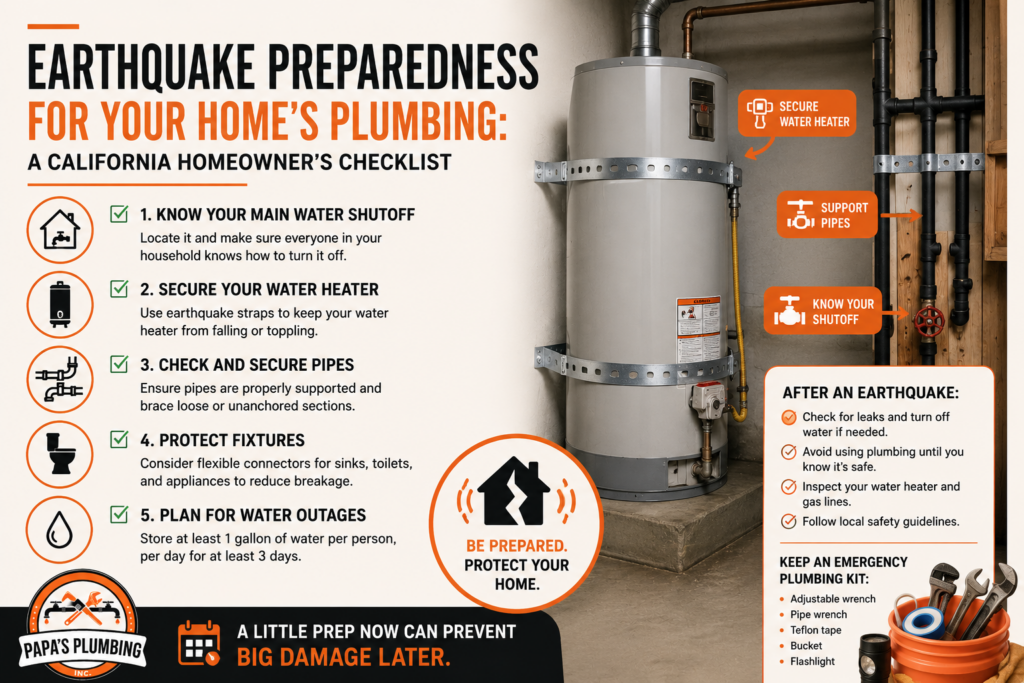
California requires every residential water heater to be strapped to the wall framing with two seismic straps: one in the upper third of the tank and one in the lower third. The straps must be metal (not strap webbing or wire) and must be anchored to wall studs, not just to drywall. This requirement has been in code since 1987, and a non-compliant water heater installation can cause home insurance complications and will fail any home inspection during a sale.
Check yours now. Open the closet or utility area where your water heater lives and look for two metal straps wrapping around the tank, with bolt or screw connections clearly visible going through drywall into wood framing behind. If you see only one strap, no straps at all, or straps that appear to be anchored only to drywall, the installation does not meet current California code.
An unsecured water heater in an earthquake has three failure modes, all bad:
- The tank topples over: A 50-gallon tank weighs roughly 400 to 500 pounds when full. Falling onto a finished floor, it crushes anything in its path and tears free from its water and gas connections.
- The supply connections rupture: When the tank moves, the rigid copper water supply and the gas line either snap or pull loose from their fittings. Water then flows from the supply line until someone shuts off the main, and gas escapes from the broken connection until someone shuts off the gas.
- The vent disconnects: Gas water heaters need their vent pipe to carry combustion byproducts to the outside. A toppled water heater that has lost its vent connection (but not its gas supply) can fill a home with carbon monoxide.
Proper strapping prevents all three. The retrofit is straightforward, takes 30 to 60 minutes, and uses inexpensive hardware available at any plumbing supply or home improvement store. A plumber can install it as a standalone job or include it during any water heater service visit.
Earthquake Gas Shutoff Valves
An earthquake gas shutoff valve (also called a seismic gas valve or earthquake shutoff valve) automatically closes the gas supply to your home when ground shaking exceeds a calibrated threshold, typically around 5.4 on the Richter scale. The valve is installed on the gas service line between the meter and the home, and it requires no electricity, no power source, and no human intervention to operate.
California does not currently require seismic gas valves on all existing homes, but many municipalities require them on new construction and major remodels, and most insurance carriers offer discounts on policies for homes that have them installed. Los Angeles County in particular has been progressively expanding requirements, and a seismic gas valve is now mandatory in many circumstances.
The reasoning is straightforward. The single highest cause of post-earthquake structure fires is gas leaks. The 1994 Northridge earthquake caused roughly 110 fires in the immediate aftermath, almost all of them attributed to broken gas lines that continued feeding fuel after the shaking stopped. A seismic gas valve cuts the supply automatically, eliminating that risk source.
The valve costs $300 to $800 for parts and $400 to $800 for installation depending on access and configuration. For a one-time investment of roughly $700 to $1,600, you eliminate one of the highest-probability post-earthquake fire risks in your home. Most installations take 2 to 4 hours and require a licensed plumber and a permit from your local building department.
Flexible Connectors for Gas Appliances
Rigid gas line connections to appliances are vulnerable to earthquake damage because they cannot flex with structural movement. California code now requires flexible gas connectors at most appliances, including water heaters, ranges, ovens, dryers, and wall furnaces. The flexible connectors absorb structural movement that would otherwise snap rigid pipe.
Check the connection at each gas appliance in your home. You should see a flexible, often stainless-steel-jacketed connector running from the rigid gas line to the appliance itself. If any of your appliances have rigid pipe connections all the way to the appliance, those connections should be updated.
This work is inexpensive and quick. A plumber can replace gas connectors at typical home’s worth of appliances in a single visit. Older flex connectors that have been in place for 20-plus years should also be inspected and often replaced regardless of earthquake concerns, because the internal flexible tubing can develop microscopic cracks over time.
Main Water Shutoff Accessibility
After an earthquake, you may need to shut off your home’s water supply quickly to prevent flooding from a broken interior line. We have covered this topic in depth in our guide to finding and using your main water shutoff valve, but earthquake preparedness adds a specific requirement: the valve needs to be accessible in conditions you might face after a quake.
Things to verify now:
- The valve is reachable without entering damaged structure: If your shutoff is inside a crawlspace or behind a closet that might be inaccessible after a major event, consider having a plumber install a secondary shutoff at a more accessible location.
- The valve handle is functional: Exercise it once a year. A seized valve handle that breaks off when you need it is worse than no valve at all.
- You can find it in the dark: Post-earthquake power outages are common. Know the location well enough to find the valve by feel.
- Tools needed to operate it are stored nearby: If your shutoff requires a curb key or other special tool, that tool should be stored where you can find it without searching.
Sewer Lateral Vulnerability and Post-Quake Inspection
Earthquakes commonly damage sewer laterals, particularly older clay and cast iron laterals that were brittle to begin with. The lateral connections at the home’s foundation and at the city main are particular failure points because the lateral spans different soil and structure conditions that move at different rates during shaking.
You may not know your sewer lateral has been damaged until weeks or months after the quake. The signs are slow: sewer smell in the yard, recurring drain backups, soggy patches of grass, sinkholes appearing along the lateral run. By the time the symptoms surface, sewage has been leaking into your yard or under your home for weeks.
For older Los Angeles homes with original clay or cast iron sewer laterals, a post-earthquake sewer camera inspection is worth scheduling after any significant seismic event. The inspection costs a fraction of what an undetected sewer leak costs over months of damage. For homes already showing wear in the lateral, proactive replacement with modern HDPE (using trenchless pipe bursting) eliminates the future earthquake vulnerability entirely.
Older Galvanized and Cast Iron: An Earthquake Risk Multiplier
Pre-1970 LA homes with original galvanized supply pipes and cast iron drains face additional earthquake risk because these materials are already brittle and weakened by decades of corrosion. The same earthquake that would simply flex modern copper or PEX often cracks aged galvanized or cast iron.
For homes still on pre-1970 plumbing materials, a planned whole-home repipe not only addresses the daily corrosion and pressure issues, it also significantly improves the home’s seismic resilience. Modern PEX supply lines flex with structural movement in ways galvanized never could, and modern PVC or ABS drain stacks tolerate shaking that would crack century-old cast iron.
If you have been considering a repipe for general plumbing reasons in an older Highland Park, Los Feliz, Pasadena, or Glendale home, earthquake preparedness is another factor on the side of doing the work.
The Five-Item Earthquake Plumbing Checklist
Before the next significant seismic event, work through this checklist for your home:
- Water heater strapping: Confirm two metal seismic straps are installed and anchored to wall framing. Retrofit if needed.
- Seismic gas valve: Evaluate whether your home has one installed at the meter. If not, get a quote on adding one.
- Flexible gas connectors: Verify every gas appliance has a flexible connector rather than rigid pipe. Replace rigid connections.
- Main water shutoff accessibility: Confirm you know the location, the handle works, and the valve is reachable after structural disruption.
- Pre-1970 plumbing assessment: If your home still has original galvanized supply or cast iron drain stacks, evaluate the timing of a planned repipe.
Most homeowners can self-verify items 1 and 4. Items 2, 3, and 5 typically require a plumber’s evaluation, but the inspection itself is straightforward and often combined with other plumbing service.
Schedule a Seismic Plumbing Assessment Today
The hard truth about earthquake preparedness is that nobody addresses it the day after the event. The work has to happen during normal time, before the shaking, when there is no urgency. The cost is modest, the benefit is significant, and most of it can be addressed in a single half-day plumbing visit.
Papa’s Plumbing Inc. is a third-generation family-owned plumber serving Los Angeles since 2015. We provide seismic plumbing assessments across LA, Glendale, Pasadena, Encino, La Cañada Flintridge, and the surrounding communities. We can install or upgrade water heater strapping, install seismic gas shutoff valves to current LA County code, replace rigid gas connectors with proper flex connections, and evaluate older plumbing materials for seismic vulnerability. Whether you have a specific concern or want a complete walkthrough of your home’s earthquake plumbing readiness, we are happy to do that as part of a routine service visit.
Call (626) 243-3689 or schedule a seismic plumbing assessment. The preparation you do today is the damage you do not face tomorrow.