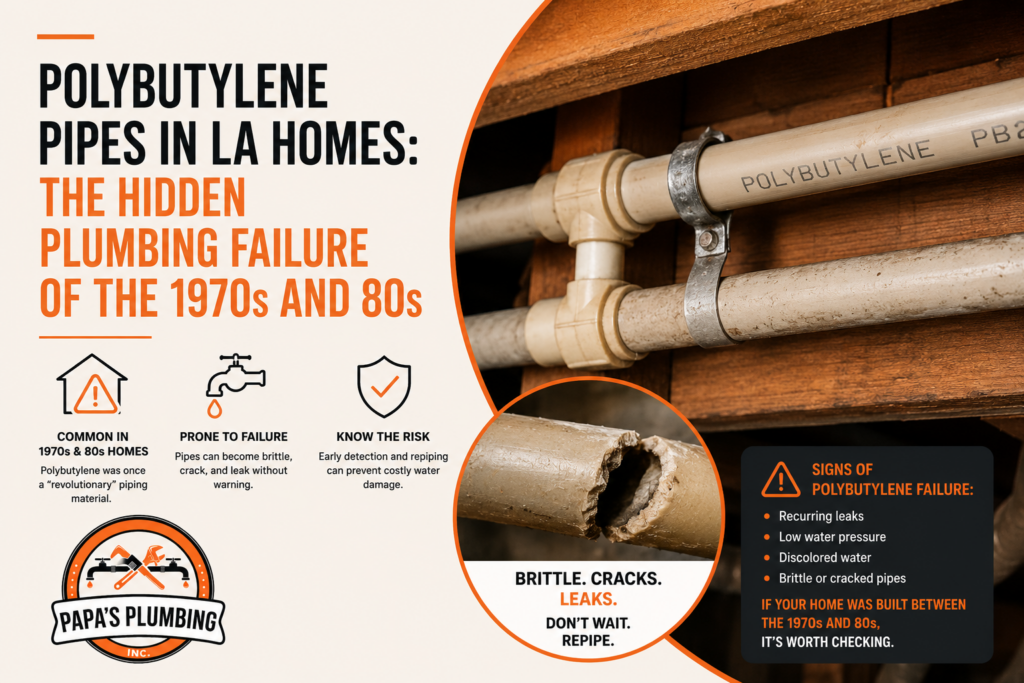




If your Los Angeles home was built or remodeled between 1978 and 1995, there is a real chance your water supply lines are made of polybutylene, a gray plastic plumbing material that was installed in millions of homes across the United States during that window and is now considered one of the most reliable failure modes in residential plumbing. Polybutylene does not slowly degrade like galvanized steel or develop pinhole leaks like aging copper. It ruptures, often without warning, often catastrophically, and often inside walls where the damage compounds for hours or days before anyone notices.
Most LA homeowners who have polybutylene plumbing do not know they have it. The pipe was a budget alternative to copper during a period of rapid home construction in the San Fernando Valley, the San Gabriel Valley, and outlying suburban LA neighborhoods. Today, the homes that still have it are running on borrowed time, and the question is not whether the system will fail but when.
Here is how to identify polybutylene in your home, why it fails so reliably, and what replacement involves.
What Polybutylene Is and Why It Was Used
Polybutylene is a flexible thermoplastic pipe manufactured between roughly 1978 and 1995. It was marketed as the future of residential plumbing: cheap to manufacture, fast to install, lightweight, and freeze-tolerant compared to copper. During its production years, polybutylene was installed in an estimated 6 to 10 million American homes, with heavy adoption in the western and southern states.
In Los Angeles specifically, polybutylene shows up most commonly in:
- San Fernando Valley tract homes built between 1978 and 1995: Encino, Sherman Oaks, Van Nuys, Reseda, Chatsworth, North Hollywood, and Lake Balboa all have polybutylene-era construction. Larger developments built during this window often used polybutylene as the standard supply material.
- San Gabriel Valley homes from the same era: Pasadena’s eastern neighborhoods, parts of Glendale, La Cañada Flintridge’s newer construction, and Arcadia all have polybutylene-era homes.
- Condos and townhomes built or remodeled in the 1980s and early 90s: Multi-unit construction was a heavy user of polybutylene during this period.
- Homes remodeled or repiped between 1978 and 1995: Even older LA homes that had their plumbing updated during this window may have polybutylene, especially if the original work was done by a budget contractor rather than a licensed plumber.
How to Identify Polybutylene Pipe in Your LA Home
Polybutylene has distinctive visual characteristics that make it easy to identify once you know what to look for. Check any exposed plumbing in your home: under sinks, behind toilets, at the water heater, inside utility closets, in garages, and at the main supply where it enters the home.
The four identifying features:
- Color: Polybutylene is almost always gray. Some installations used blue or black pipe, but gray is by far the most common. The gray is dull and matte, not glossy.
- Flexibility: The pipe is flexible enough to bend by hand, unlike rigid copper or PVC. You can usually flex a polybutylene supply line slightly without disconnecting it.
- Diameter: Common sizes are 1/2 inch and 3/4 inch, matching standard residential supply diameters.
- Fitting connections: Polybutylene pipe was joined to fittings using either crimped copper rings or plastic insert fittings with metal bands. The fitting style at each joint is often the first thing that fails.
- Stamped markings: Most polybutylene pipe was stamped with “PB2110” or similar codes along the length of the pipe at regular intervals. If you see these markings on gray pipe, you have polybutylene.
If you find polybutylene at any exposed location in your home, assume the entire supply system is the same material. Polybutylene was almost always installed as a complete system rather than as patchwork repairs, so finding it under one sink usually means finding it behind every wall.
Why Polybutylene Fails So Reliably
Polybutylene’s failure mode is well-documented and was the subject of one of the largest class-action settlements in plumbing history. The pipe and its associated fittings reacted with the chlorine and other oxidants present in municipal water supplies, including LADWP, LA County water districts, and most Southern California utilities. The reaction caused the plastic to become brittle from the inside out over a period of 10 to 25 years, eventually leading to cracks, ruptures, or fitting failures.
The failure pattern is what makes polybutylene particularly dangerous:
- Failures are sudden: Unlike galvanized pipe that gradually loses pressure or develops pinhole leaks, polybutylene typically does not give warning. The pipe is intact one day and split the next.
- Failures often happen at fittings, not in the pipe itself: The plastic fittings used in many polybutylene systems are even more prone to failure than the pipe. A joint that has held for 30 years can let go in a single moment.
- Failures often happen inside walls: Most polybutylene runs through wall cavities, attics, and crawlspaces where the failure is invisible. Water can run for hours or days before surfacing as ceiling staining, drywall bubbling, or floor damage.
- Failures often happen during pressure spikes: Municipal water pressure can spike during hydrant testing, line repairs, or normal demand fluctuations. Polybutylene that has been quietly aging often fails during one of these spikes rather than at a steady-state condition.
The class-action settlement that addressed polybutylene failures, Cox v. Shell Oil, paid out billions of dollars to homeowners between 1995 and 2009. That settlement is now closed. Any homeowner who discovers polybutylene in their home today is fully responsible for the cost of replacement.
Why LA Specifically Sees Heavy Polybutylene Failure
Three factors make LA homes with polybutylene particularly vulnerable:
Chlorinated water supply: LADWP and most LA County water districts add chlorine and chloramine to their water for disinfection. These oxidants are the same chemicals that caused polybutylene to deteriorate in the first place. LA homes have been receiving chlorinated water continuously since the polybutylene was installed, which means the degradation has been happening 24 hours a day for 30 to 45 years.
Hard water mineral content: LA’s water hardness combines with the chlorine reaction to accelerate fitting failure. Mineral deposits build up around fittings and put additional mechanical stress on connections that are already weakening chemically.
Seismic activity: Earthquake events large enough to flex a home’s framing put additional stress on rigid plumbing connections. Polybutylene fittings that are already compromised often fail in the days or weeks following a noticeable quake.
What to Do If You Find Polybutylene in Your LA Home
The only real solution is a whole-home repipe with modern materials. Spot repairs on polybutylene buy you weeks or months, not years. The pipe and fittings continue to degrade throughout the system, and replacing one failed section while leaving the rest in place is a guaranteed way to deal with another emergency soon.
A polybutylene repipe replaces all of the gray plastic supply lines with either copper or PEX (cross-linked polyethylene). PEX is the most common modern choice because it shares polybutylene’s flexibility and installation speed without the chemical vulnerability. Modern PEX is formulated specifically to resist chlorine and oxidant exposure, and it carries warranties of 25 to 50 years from major manufacturers.
The replacement work in a typical LA polybutylene home runs three to five working days. We open small access points in walls, ceilings, and floors to thread new lines through, then patch and refinish each opening so the work is largely invisible once complete. The plumbing permit pulled with the City of LA Department of Building and Safety provides documentation that the polybutylene has been removed, which is valuable both for current insurance and for future resale.
Insurance Implications of Polybutylene Plumbing
Many homeowner’s insurance carriers now treat polybutylene as a known risk factor. Some carriers will not issue new policies on homes with polybutylene plumbing, others will issue policies but exclude water damage from polybutylene failures, and some will charge higher premiums or require a repipe within a specified period after policy issuance.
If you are buying a home built or remodeled between 1978 and 1995, two things are worth doing during your contingency period:
- Have a plumber identify whether the home has polybutylene: This can be done during a standard plumbing inspection by checking exposed pipe at the water heater, under sinks, and at the main supply.
- Get insurance quotes that disclose the polybutylene: This avoids the unpleasant surprise of discovering after closing that your new home is harder or more expensive to insure than you expected.
If you own a home with polybutylene and are not planning to sell, the repipe still pays for itself over the long run. Insurance savings, eliminated risk of catastrophic water damage, and increased property value at eventual sale typically offset the project cost within 5 to 10 years.
What a Modern Repipe Looks Like
The same repipe process that removes polybutylene also removes any aging galvanized supply lines that may have been part of the original construction. Many LA homes built between 1978 and 1995 had partial polybutylene runs combined with galvanized supply at the main connection, which means a repipe addresses both materials at once.
The work proceeds in a predictable sequence:
- Inspection and quote: A plumber walks the home, identifies all polybutylene and any other aging materials, and provides a flat-rate quote for the complete replacement.
- Permit pulled: The City of LA, Glendale, Pasadena, or relevant jurisdiction issues a plumbing permit. The job is officially documented.
- Wall access: Small access points are opened where new pipe needs to run, typically in closets, behind appliances, and at strategic interior locations.
- New supply lines installed: Copper and PEX are routed throughout the home, connecting to each fixture and the main water supply.
- Pressure testing: The new system is tested at higher than normal pressure to verify all joints and runs are leak-free before walls are closed.
- City inspection: A building department inspector verifies the work meets code.
- Wall closure and finishing: All access points are patched, textured, and painted to match surrounding surfaces.
- Final walkthrough: The plumber confirms all fixtures function properly and provides documentation of the work.
Schedule a Polybutylene Inspection Before You Need an Emergency Call
If your LA home was built or remodeled between 1978 and 1995 and you have not had a plumber confirm what materials are in your walls, that inspection is worth the visit. We provide polybutylene identification as part of standard plumbing inspections throughout LA, the San Fernando Valley, and the San Gabriel Valley. If we find polybutylene, we explain what your options are honestly, and we do not pressure homeowners into immediate replacement if their system shows no current failure signs. But we do tell you the truth: every polybutylene system in LA is on a countdown, and the only question is whether you control the timing or whether the timing controls you.
Papa’s Plumbing Inc. is a third-generation family-owned plumber serving Los Angeles since 2015. We have done polybutylene repipes across Encino, Sherman Oaks, North Hollywood, Chatsworth, and the broader Valley and Pasadena areas. See our full water line repair and replacement services for repipe details, or call (626) 243-3689 to schedule a polybutylene inspection. The clear expectations from knowing what is actually behind your walls is worth the visit.