



If you have a tankless water heater in Encino and you have not had it descaled in the past 12 months, you are running on borrowed time. Encino’s water supply, delivered by LADWP from a blend of Owens Valley aqueduct water and Metropolitan Water District imports, carries enough dissolved calcium and magnesium to coat the inside of a tankless heat exchanger in mineral scale within months. Skip annual descaling for two or three years and you have either voided your manufacturer warranty, dropped your unit’s efficiency by 20 to 40 percent, or both.
Here is what tankless water heater maintenance actually involves in Encino specifically, why hard water makes it non-negotiable, and what happens to the units of homeowners who skip it.
Why Encino Tankless Units Scale Faster Than the LA Average
Tankless water heaters work by passing cold water through a heat exchanger where gas burners or electric elements heat it on demand. The water moves quickly across copper or stainless steel coils that get extremely hot, which is exactly the condition that causes dissolved minerals in the water to precipitate out and bond to the metal surfaces. The hotter the surface, the faster the scale forms.
Encino properties served by LADWP receive water classified as moderately hard to hard in mineral content. The Owens Valley aqueduct portion carries natural mineral content from the eastern Sierra watershed, and the MWD imports from the Colorado River carry significant calcium content from the desert sedimentary rock the water passes through. Blended together at the Encino-area distribution points, the resulting tap water deposits scale aggressively on any heated metal surface it touches.
For Encino homeowners, this means two specific realities for tankless ownership:
- Annual descaling is not optional. It is a manufacturer-required maintenance interval that LADWP-served homes need to follow strictly to avoid voiding warranties.
- Tankless units in Encino without softeners installed need descaling more aggressively than units in soft-water regions. The default 12-month interval assumes average water hardness, which Encino exceeds.
What Happens When You Skip Tankless Descaling
Mineral scale acts as insulation between the heat exchanger and the water flowing through it. As scale layers build up, the burner has to work harder and run longer to deliver the same hot water at the same temperature. The first symptom most Encino homeowners notice is that their tankless unit takes longer to deliver hot water to the tap, even though the unit itself fires up the moment a fixture is opened.
From there, the failure mode progresses predictably:
- Months 12 to 18 of no maintenance: Efficiency drops 10 to 15 percent. Monthly gas bills creep up. Hot water delivery slows slightly. Most homeowners do not notice or attribute it to other causes.
- Months 18 to 30: Efficiency drops 20 to 30 percent. The unit cycles more frequently, the heat exchanger runs hotter, and internal sensors begin tripping the unit into error codes during heavy demand. Hot water may run cold during simultaneous shower use.
- Months 30 to 48: Heat exchanger scale becomes severe enough that internal flow sensors throw permanent error codes. The unit refuses to fire. At this point, descaling may or may not recover the unit. Often replacement is the only option.
- Year 4 to 6: Heat exchanger failure is common in unmaintained units. Manufacturer warranties on tankless heat exchangers run 10 to 15 years, but those warranties explicitly require documented annual descaling. No service records means no warranty coverage, and a new heat exchanger replacement on most tankless units costs nearly as much as a new unit.
For comparison, a properly maintained tankless unit in Encino should run 15 to 20 years before any major service is required. The difference between 5-year failure and 20-year service life is annual descaling.
What Tankless Descaling Actually Involves
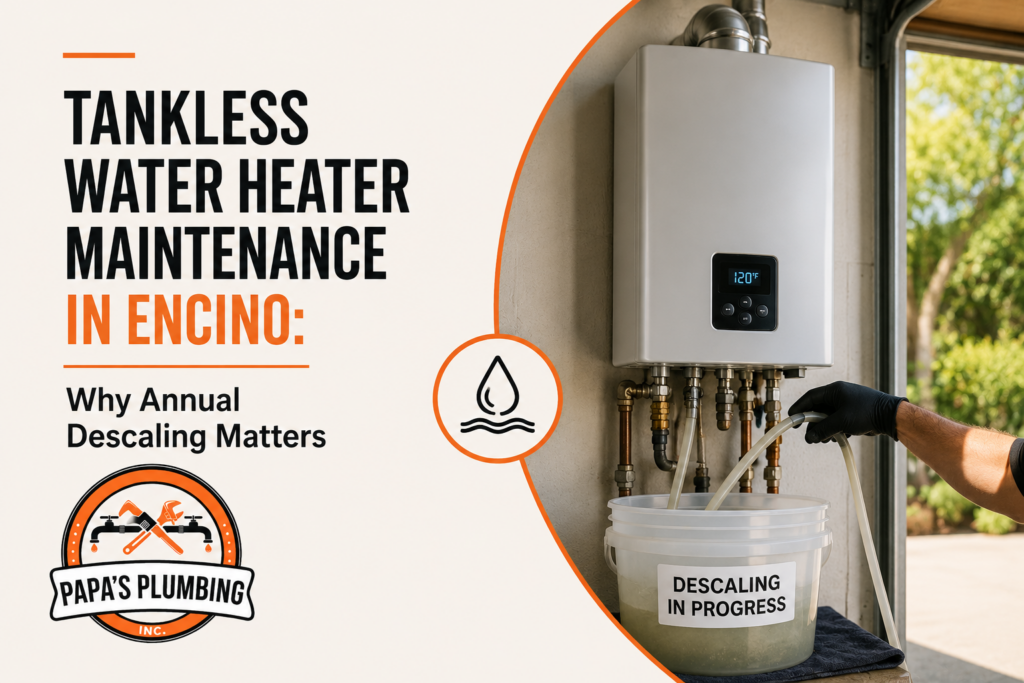
The descaling process is straightforward but requires the right equipment and access points. Here is what we do during a typical Encino tankless maintenance visit.
- Power down and isolate the unit: We turn off the gas supply (or electric breaker on electric units), shut off the cold water inlet, and close the hot water outlet valve. The unit needs to be fully isolated from the home’s water and gas supply for safety and effective descaling.
- Connect a recirculation pump and bucket: We attach a small pump and hose system to the unit’s service valves, which are isolation valves with hose connections that most tankless units have on the hot and cold sides. If the unit was installed without service valves, we install them as part of the visit (this is a one-time addition that pays back every year going forward).
- Circulate descaling solution through the heat exchanger: We fill the bucket with white vinegar or a manufacturer-approved descaling solution, then run the pump for 45 to 90 minutes depending on scale severity. The acidic solution circulates through the heat exchanger, dissolving the mineral deposits and carrying them back to the bucket.
- Flush the system with clean water: After descaling, we run clean water through the system to flush out any remaining solution and dissolved scale. This takes 10 to 15 minutes.
- Clean the inlet water filter and burner assembly: Most tankless units have a small mesh filter at the cold water inlet that catches sediment. We pull and clean this filter. For gas units, we also visually inspect the burner assembly and clean any debris.
- Restore service and verify operation: We open the inlet and outlet valves, restore gas or electric service, and run the unit through a test cycle to confirm it heats water to spec and shows no error codes.
- Document the service: We provide a written service record with the date, the work performed, and the unit’s condition. This documentation is what preserves your manufacturer warranty.
A typical Encino descaling visit runs 60 to 120 minutes for a single tankless unit. Larger homes with multiple tankless units or unusually heavy scale may run longer.
Should You Add a Water Softener to Protect Your Tankless?
For Encino homes with LADWP water and existing tankless installation, a whole-home water softener is one of the most cost-effective protective investments available. The softener removes the calcium and magnesium before water reaches the tankless unit, which dramatically slows scale formation and extends the time between descaling visits.
With a softener installed, tankless descaling can often move from annual to every 18 to 24 months without warranty issues. The softener also protects your fixtures, washing machine, dishwasher, and tank-style appliances throughout the home. Most softener installations pay back over 5 to 10 years through extended appliance life and reduced soap and detergent use.
For Encino Hills properties and the larger 91436 estate homes that often have multi-zone tankless setups, a softener is typically a necessary part of any new tankless installation. We recommend evaluating the existing water hardness and the tankless load before quoting, so the softener size matches the actual demand.
Warning Signs Your Encino Tankless Needs Descaling Now
If you cannot remember the last time your tankless was serviced, or if any of these symptoms are showing up, descale before another month passes.
- Hot water takes longer to arrive at the tap than it did when the unit was new.
- Hot water temperature fluctuates during a single shower or when multiple fixtures are running.
- The unit cycles on and off more frequently than you remember from earlier years.
- Error codes appear on the unit’s display, particularly codes related to flow rate, ignition, or heat exchanger overheating.
- Hot water flow rate has dropped: filling a sink or bathtub takes noticeably longer than it used to.
- The unit makes new noises: rumbling, whistling, or popping that was not present when the unit was newer.
- Monthly gas bills have crept up without a change in usage patterns.
Each of these is a symptom of scale buildup affecting the heat exchanger. Catching them early means descaling restores efficiency. Catching them late often means heat exchanger damage that descaling cannot reverse.
Schedule Encino Tankless Maintenance Before You Need an Emergency Call
The cost difference between annual maintenance and reactive emergency replacement is significant. A descaling service visit costs a small fraction of what a new tankless unit and installation costs. Annual maintenance also preserves your manufacturer warranty, which is the safety net for any unexpected failure during the unit’s first decade of service.
Papa’s Plumbing Inc. is a third-generation family-owned plumber serving Encino and the surrounding Valley communities since 2015. We provide tankless maintenance on Rinnai, Navien, Noritz, Takagi, Rheem, and other major brands. Whether you need a routine annual descaling, a tankless installation for a home that is converting from a tank unit, or emergency service on a tankless unit that has stopped firing, we have the equipment and the experience to handle it. See our full water heater services for tank and tankless work across LA.
Call (626) 243-3689 or request an Encino tankless maintenance appointment. The unit you protect today is the unit you do not have to replace in five years.