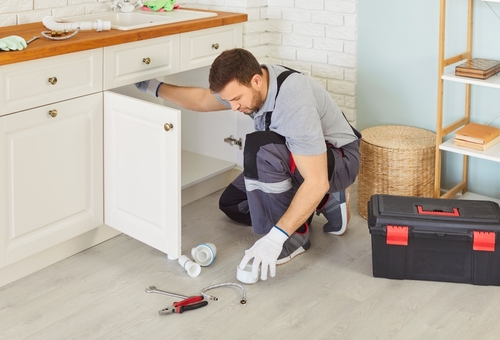




Quick Answer: If a pipe is leaking under your sink, the first step is to turn off the water supply using the shut-off valves located directly below the sink. Place a bucket or towel under the leak to catch water and prevent cabinet damage. The most common causes are loose compression fittings, a worn-out supply line connector, a cracked P-trap, or a failed drain basket seal. Simple connection tightening can be done yourself, but if the pipe itself is cracked or corroded, call a licensed plumber for fixture repair.
A leak under the sink is one of those problems that can go undetected for weeks because you only see it when you open the cabinet. By the time you notice, the cabinet floor may be warped, mold may be starting to form, and the damage has already exceeded what the leak itself would have cost to fix. Here is how to handle it.
Step 1: Stop the Water
Look under the sink for two small valves on the wall, one for hot and one for cold. Turn both clockwise until they stop. If the valves are seized and will not turn (common in older LA homes where the valves have not been operated in years), turn off the main water supply to the house.
Once the water is off, dry the area under the sink and place towels or a shallow pan to catch any remaining drips. Open the cabinet doors to let the area air out and start drying.
If the leak is coming from the drain side (not the supply side), the shut-off valves will not stop it because drain water only flows when the faucet is running or the basin is draining. In that case, stop using the sink until the drain connection is repaired.
Step 2: Identify the Source
Under-sink leaks come from three distinct systems, and the fix depends on which one is leaking.
Supply line connections are the flexible hoses or rigid chrome tubes that connect the shut-off valves to the faucet. These connections can loosen over time, and the flexible braided hoses have rubber washers that wear out after 5 to 10 years. If water is dripping from where the supply line meets the valve or the faucet, try gently tightening the compression nut with an adjustable wrench. If the leak stops, you are done. If it does not, the washer or the hose itself needs replacing.
Drain connections include the P-trap (the curved pipe section), the tailpiece (the straight pipe from the sink drain to the P-trap), and the slip-joint nuts that connect them. These connections use nylon washers and compression fittings that can crack or degrade. If water leaks when you run the faucet or drain the basin, the issue is in the drain assembly. Check that all slip-joint nuts are hand-tight plus a quarter turn with pliers. Over-tightening can crack the nuts, so be careful.
The drain basket or strainer is the fitting at the bottom of the sink basin where water enters the drain. It is sealed with plumber’s putty or a rubber gasket. If the seal fails, water seeps around the drain opening every time the basin holds water. You will see water dripping from the very top of the tailpiece where it connects to the sink. Replacing the drain basket seal is a straightforward repair for a plumber and falls under standard fixture service.
When the Leak Is a Symptom of a Bigger Problem
A single leaking connection under a sink is a routine repair. But there are situations where the under-sink leak points to a larger issue.
If the supply lines are galvanized steel (rigid, gray-colored pipes rather than flexible braided hoses), corrosion at the connection point usually means the pipes themselves are deteriorating. Fixing one connection will not prevent the next one from failing. In older Los Angeles homes, this is often the first visible sign that a water line replacement is approaching. We have written about signs of a burst pipe and whole-house repiping for homeowners facing this situation.
If the P-trap or drain connections are cast iron rather than PVC or ABS, and the leak is coming from a crack or corroded section rather than a loose fitting, the cast iron drain pipe has reached end of life. Patching corroded cast iron is a temporary fix. The section needs to be cut out and replaced with PVC, which your plumber can do during a single service call.
If you notice hidden leaks or water damage beyond what the visible leak could have caused, water may also be coming from inside the wall behind the sink. A plumber can inspect the full connection area to rule out a leak in the supply line inside the wall.
Preventing Future Under-Sink Leaks
Replace flexible braided supply lines every 8 to 10 years, even if they are not leaking. The rubber washers and braided stainless housing degrade over time, and a supply line failure when you are not home can cause major water damage.
Inspect under every sink in your house once every few months. Look for moisture, water stains on the cabinet floor, or any mineral deposits on pipe connections. Catching a drip early keeps it a $50 repair instead of a $5,000 water damage claim.
Test the shut-off valves under each sink annually. Turn them off and on to make sure they work. A valve that is seized open when you need it during an emergency is the same as having no valve at all. We have emphasized this in our guide to preventing plumbing emergencies.
When to Call a Plumber
If the leak is from a corroded pipe rather than a loose connection, if you cannot identify the source, if the shut-off valves will not close, or if the leak is inside the wall, call a professional. Contact Papa’s Plumbing for under-sink leak repair throughout the Los Angeles area, including Lake Balboa, Tujunga, La Canada Flintridge, and North Glendale.
Frequently Asked Questions
Can I use tape to fix a leaking pipe under the sink? Plumber’s tape (Teflon tape) can temporarily slow a leak at a threaded connection, but it is not a permanent repair. If the pipe itself is cracked, no amount of tape will hold. Tape is a stop-gap until you can get the connection properly repaired.
Why is my sink leaking only when I run the garbage disposal? The leak is likely at the disposal flange (where the unit connects to the sink basin) or at the discharge connection (where the drain hose exits the disposal). Disposal flanges use a mounting ring and plumber’s putty that can fail over time. A plumber can reseat or replace the flange during a routine service call.
Should I replace PVC drain pipes under my sink? PVC drain pipes have a very long lifespan (50+ years) and rarely need replacement unless they are physically damaged. If a PVC connection is leaking, the issue is usually the slip-joint washer, not the pipe. Replacing the washer is a $5 part and a ten-minute repair.
How much does it cost to fix a leaking pipe under a sink? A simple connection repair or supply line replacement typically costs $100 to $250 for a service call. If the P-trap or drain assembly needs replacing, expect $150 to $350. If the leak involves corroded galvanized supply lines inside the wall, the cost increases depending on the scope of the residential plumbing work required.