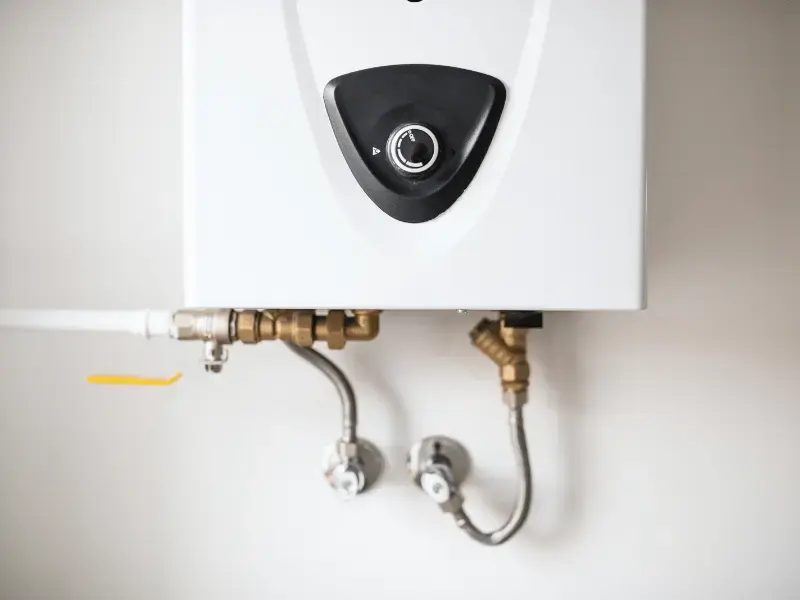




Quick Answer: To prevent sediment in water heater systems, keep the thermostat near 120°F, flush the tank at least yearly, trap grit with a sediment pre-filter, and reduce hard-water minerals with a water softener. Watch early warning signs like rumbling/popping, lukewarm water, cloudy or rust-colored hot water, and low hot-water pressure. These steps cut overheating, corrosion, and T&P valve stress helping your heater last longer and run cheaper.
Why Sediment Forms in Water Heaters
Sediment forms when dissolved solids and suspended solids in your water settle and harden inside the tank.
Sediment isn’t “one thing.” It’s a mix of hard water minerals (especially calcium and magnesium) plus particles like sand, silt, clay, dirt/debris, and even rust particles. When water is heated, mineral precipitation happens faster, so those minerals drop out of the water and collect at the tank bottom.
In many homes, the combination of aging plumbing infrastructure and mineral-rich supplies can increase particle load. If your home is on municipal (city) water, sediment can still show up due to aging water mains, occasional water-main breaks/leaks, or shifts in flow that stir deposits. If you’re on private well water, particles can enter from a drilling process (new well), or problems like well casing cracks or well screen damage.
What “Inside Tank Sediment” Actually Does to Your Water Heater
Sediment creates an insulating layer that forces your heater to work harder and overheat.
Once sediment settles in a water heater tank (storage tank), it forms an insulating sediment layer (insulation barrier) between the water and the heating element (or the gas flame). That reduces heat transfer, so the system runs longer. Over time, the tank’s thermostat may call for more heat, which increases stress and can lead to premature component failure.
Common Damage Pathways Sediment Triggers
- Heat gets trapped → overheating and accelerated wear.
- The tank interior lining can break down → steel tank corrosion starts.
- Hot spots increase pressure events → the temperature & pressure (T&P) relief valve works harder.
- Sediment can clog outlets or narrow the hot water line / pipe walls, reducing flow.
Hot Water Heater Sediment Symptoms (Catch It Early)
The earliest clues are noise, weaker heat, and changes in water color or pressure.
Here are the most consistent hot water heater sediment symptoms homeowners notice:
- rumbling / popping noises when the burner or element runs
- hissing / sizzling sounds (steam bubbles trapped under chunks)
- lukewarm water even with the dial turned up
- longer wait time for hot water at taps
- cloudy water from suspended particles
- rust-colored (orange/reddish) hot water from corrosion and debris
- low hot water pressure / decreased flow on hot side only
- higher gas or electricity bills because it runs longer
If two or more show up together, your tank likely has inside water heater sediment that needs attention. If you’re already noticing unusual sounds, especially a gurgling water heater, it may indicate sediment buildup has started trapping steam at the bottom of the tank.
How to Prevent Sediment in Water Heater (The Core Strategy)
Prevention is a combination of temperature control, filtration, and routine flushing.
To build long-term protection, think of prevention as a “3-layer defense”:
- Stop sediment from entering (filters / supply control)
- Stop minerals from forming deposits (temperature + softening)
- Remove what still settles (flushing schedule)
You’ll see the phrase how to prevent sediment in a water heater throughout this guide because that’s the outcome each step supports: stopping buildup before it becomes damaged.
Step 1 - Set the Water Heater to 120°F (Deposit Control)
Keeping your heater around 120°F (49°C) slows mineral precipitation and reduces scale.
Higher water temperatures can cause more rapid mineral precipitation, which increases sediment build up in water heater tanks. Setting the thermostat to around 120°F is a strong balance: hot enough for normal household needs, but lower stress on components. It also lowers scald risk and can reduce energy consumption.
Tip: If you’re fighting recurring deposits, temperature control is the easiest “set-it-and-forget-it” win.
Step 2 - Add a Sediment Filter Where It Helps Most
A sediment pre-filter traps sand, silt, rust, and debris before it reaches the tank.
If you’ve ever seen murky water after hydrant work, a main repair, or heavy rain near wells, you’re seeing the same particle load that later becomes sediment from water heater drains.
A sediment filter is mechanical filtration that captures particles like sand, silt, clay, dirt/debris, and rust particles. It reduces the “incoming load,” protecting the tank, fixtures, and appliances.
Signs You Should Consider a Sediment Pre-Filter
- Your water occasionally looks cloudy, especially after outages
- You see grit in faucet aerators
- You have a history of mainline work or older neighborhood mains
- Your tank flush drains brown or sandy water repeatedly
- You’re on well water and get periodic turbidity after storms
Important detail: Sediment filters target particles, not dissolved minerals. If calcium/magnesium are high, pair filtration with softening.
Step 3 - Use a Water Softener for Hard Water Minerals
A water softener reduces calcium and magnesium so fewer deposits can form.
Hard water minerals especially calcium and magnesium are major drivers of tank deposits. A water softener reduces those minerals, which means less deposit formation and slower buildup inside the tank and on the heating element.
Softening also reduces scaling in household plumbing, helping protect hot water line / pipe walls and fixtures.
Step 4 - Flushing Water Heater Sediment (Safely and Effectively)
A controlled flush removes settled particles and prevents the insulating layer from thickening.
If you already have sediment, prevention includes removal. The simplest routine is to flush once per year, and more often if you have heavy mineral load or frequent debris.
Many homeowners also like to drain a hot water heater safely before winter to reduce stress during colder months when hot water demand spikes.
Quick DIY Flush Steps
- Turn off power (electric) or set gas to pilot/off; let water cool.
- Connect a hose to the drain valve and route to a safe drain.
- Open a hot faucet in the home to prevent vacuum lock.
- Open the drain valve; drain until it runs clearer.
- Briefly pulse the cold supply to stir and carry sediment out.
- Close the valve, refill fully, purge air, then restore power/gas.
Quick fix: If your hot water is suddenly weak after a water-main event, a short drain-and-refill can clear fresh debris before it hardens.
Cleaning Sediment Out of Water Heater Without Damaging the Tank
Go slow, avoid overheating, and don’t force stuck valves or fittings.
When cleaning sediment out of water heater tanks, the biggest risk is rushing. If the tank is extremely hot, draining can stir and bake deposits into a harder layer. Letting it cool and pulsing gently can reduce that risk.
If the drain valve clogs or trickles, don’t crank aggressively. Sediment can jam the valve opening. Sometimes a short supply pulse dislodges it; sometimes the valve needs replacement.
This is where trained residential plumbing specialists can help when DIY steps don’t restore normal drain flow safely.
Symptom → Likely Cause → What to Do First
Symptom | Likely Sediment-Related Cause | First Action to Take |
Rumbling/popping | Steam bubbles under hardened deposits | Flush until clear; lower temp to 120°F |
Lukewarm water | Insulating layer blocking heat transfer | Flush; check thermostat setting |
Rust-colored hot water | Corrosion releasing rust particles | Inspect tank lining; check anode; flush |
Low hot-water pressure | Sediment narrowing outlets/lines | Flush; inspect hot-side aerators |
Leaking near T&P | Overheating/pressure events | Check temperature; test/replace T&P |
Higher utility bills | Longer heating cycles | Flush; insulate tank; check setting |
Insulate the Tank and Pipes to Reduce Temperature Swings
Insulation stabilizes temperature and reduces workload that accelerates deposits.
Insulation doesn’t “remove sediment,” but it can reduce cycling and heat loss, meaning fewer aggressive heating cycles that speed deposit formation. A tank blanket and pipe insulation help in garages and unconditioned spaces.
This is one of the simplest tips to extend the life of a water heater because it reduces wear on core components.
Protect the T&P Relief Valve and Avoid Pressure Damage
Sediment indirectly increases pressure risk by forcing hotter operation and stressing safety components.
Your temperature & pressure (T&P) relief valve is the heater’s safety release. Sediment makes heat transfer inefficient, so the unit runs hotter/longer, increasing tank stress. A failing relief valve can leak, stick, or fail to discharge properly.
If you notice repeated relief valve dripping, unusual overheating, or frequent pressure events, treat it as urgent pressure issues can escalate.
Prevent Corrosion: Anode Rod, Tank Lining, and Steel Protection
Corrosion prevention reduces rust and tank damage that can mix with sediment.
Sediment is often paired with corrosion. When deposits sit against metal surfaces, they can create conditions that accelerate damage to the tank interior lining, exposing steel and causing steel tank corrosion. That corrosion produces rust particles, which worsen discoloration and buildup.
Annual inspections often include checking corrosion indicators and protecting the tank’s internal chemistry.
Gas vs Electric: Where Sediment Causes Different Problems
Gas heaters suffer from heat concentration and noise; electric heaters lose efficiency when the element gets coated.
In a gas heater, sediment piles on the bottom can increase noise and reduce heat transfer from the base area. In electric heaters, sediment often collects and coats the heating element, acting like a jacket that blocks heat. Over time, that can increase cycling and stress on the thermostat.
In gas units, technicians may inspect the burner assembly (gas heater) for soot/combustion issues that can compound heating inefficiency.
Test Your Water Quality (So You Stop the Cause, Not Just the Symptoms)
Testing tells you whether you’re fighting particles, minerals, or both.
If sediment keeps returning after a flush, the source is upstream. Your water may carry high total dissolved solids or gritty particles that need filtration. Basic water tests often look at:
- pH
- hardness (calcium/magnesium levels)
- iron/manganese (staining/corrosion indicators)
- turbidity (cloudiness from suspended solids)
You don’t need to overcomplicate it test enough to choose the right defense (softening vs filtering vs both).
Prevention Schedule by Water Type (Simple Maintenance Map)
Water Supply Type | Common Risk | Best Prevention Setup | Flush Frequency |
Municipal (city) water | Deposits from water mains; occasional debris | Sediment pre-filter + temp at 120°F | Yearly (or after main events) |
Private well water | Sand/silt after storms; casing/screen issues | Sediment filter + periodic well check | 1–2x yearly |
Very hard water | Heavy mineral precipitation | Water softener + temp at 120°F | 1–2x yearly |
Mixed issues | Minerals + particles | Softener + sediment filtration | 2x yearly |
Mistakes That Make Sediment Problems Worse
Overheating, skipping flushes, and ignoring early signs speeds failure.
Avoid these Common Mistakes
- Setting the temperature too high “to get hotter showers faster.”
- Waiting for full failure instead of acting at first noise/pressure change.
- Flushing without letting water cool first (bakes deposits harder).
- Ignoring cloudy/rust-colored hot water until corrosion accelerates.
- Forgetting that filtration and softening solve different problems.
Practical Prevention Checklist (Do This Monthly)
A quick monthly check catches buildup before damage.
- Listen for new noises during heating cycles.
- Compare hot vs cold pressure at one faucet.
- Watch for cloudiness or orange tint in hot water.
- Check around the tank base for moisture.
- Track any sudden bill increases.
If you’re unsure what’s normal, best water heater experts can confirm whether the issue is sediment, pressure, corrosion, or another cause before it becomes a replacement event.
When DIY Stops and You Should Call a Pro
Call for help when safety parts leak, draining fails, or corrosion is suspected.
If any of these happen, don’t push DIY further:
- Persistent T&P valve leaking
- Tank or fittings show cracks or active leakage
- Drain valve is blocked and won’t clear
- You repeatedly see rust-colored hot water
- You suspect corrosion damage
If you need hands-on help that keeps costs predictable, an affordable plumbing company can handle flushing, valve checks, and filtration installs without guesswork.
Call Papa’s Plumbing Inc. Before Sediment Turns Into Damage
If your tank is making noise, your hot water is turning cloudy, or you want a professional flush and prevention setup, Papa’s Plumbing Inc. can help you stop sediment before it shortens your heater’s life. Call: 6262433689 to schedule service and keep your hot water reliable.
FAQs About Preventing Sediment Build up in Water Heater
How to prevent sediment in water heater if I have hard water?
Set the heater to 120°F, install a water softener, and flush the tank at least once per year. Hard water minerals (calcium and magnesium) deposit faster at higher temperatures, so temperature control plus softening is the best combo.
What are the fastest warning signs that sediment is building up?
The fastest signs are rumbling/popping, lukewarm water, longer wait time for hot water, cloudy water, and low hot water pressure on the hot side only.
How often should I flush the tank to prevent buildup?
Most homes benefit from annual flushing. If you have very hard water or frequent debris events, flush twice a year.
Is sediment the same as scale?
Sediment can include particles (sand/silt/rust) and mineral deposits, while “scale” often refers specifically to hardened mineral deposits from hard water. Both reduce efficiency and can increase damage risk.
Can sediment cause leaks and valve problems?
Yes. Sediment can contribute to overheating and corrosion, stressing the tank and increasing pressure events that can lead to T&P relief valve issues and leaks.
What’s the safest temperature setting to reduce sediment and scalding risk?
120°F (49°C) is the commonly recommended setting for safety and efficiency, and it helps slow deposit formation.